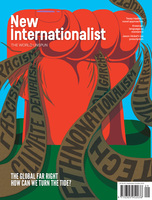
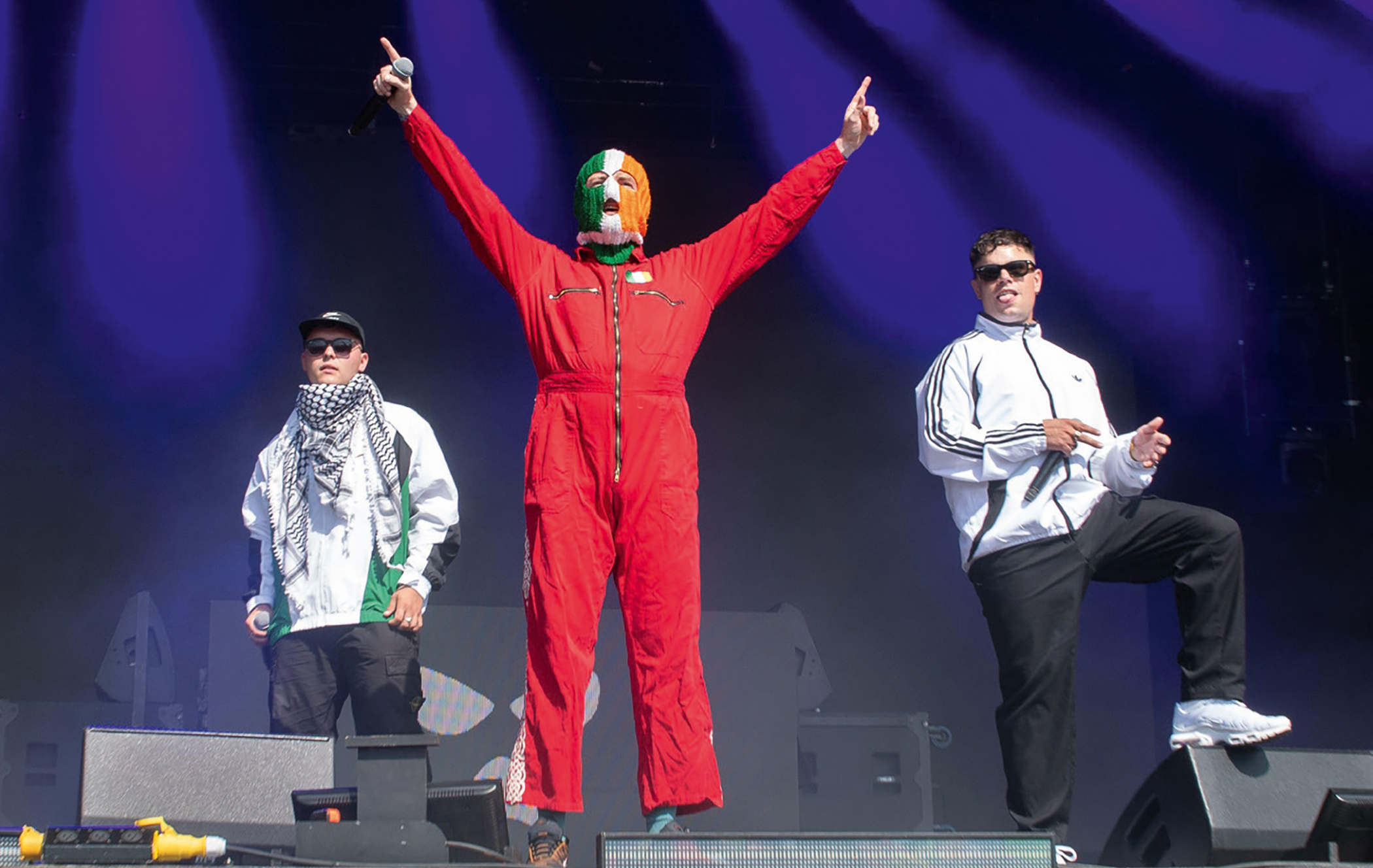
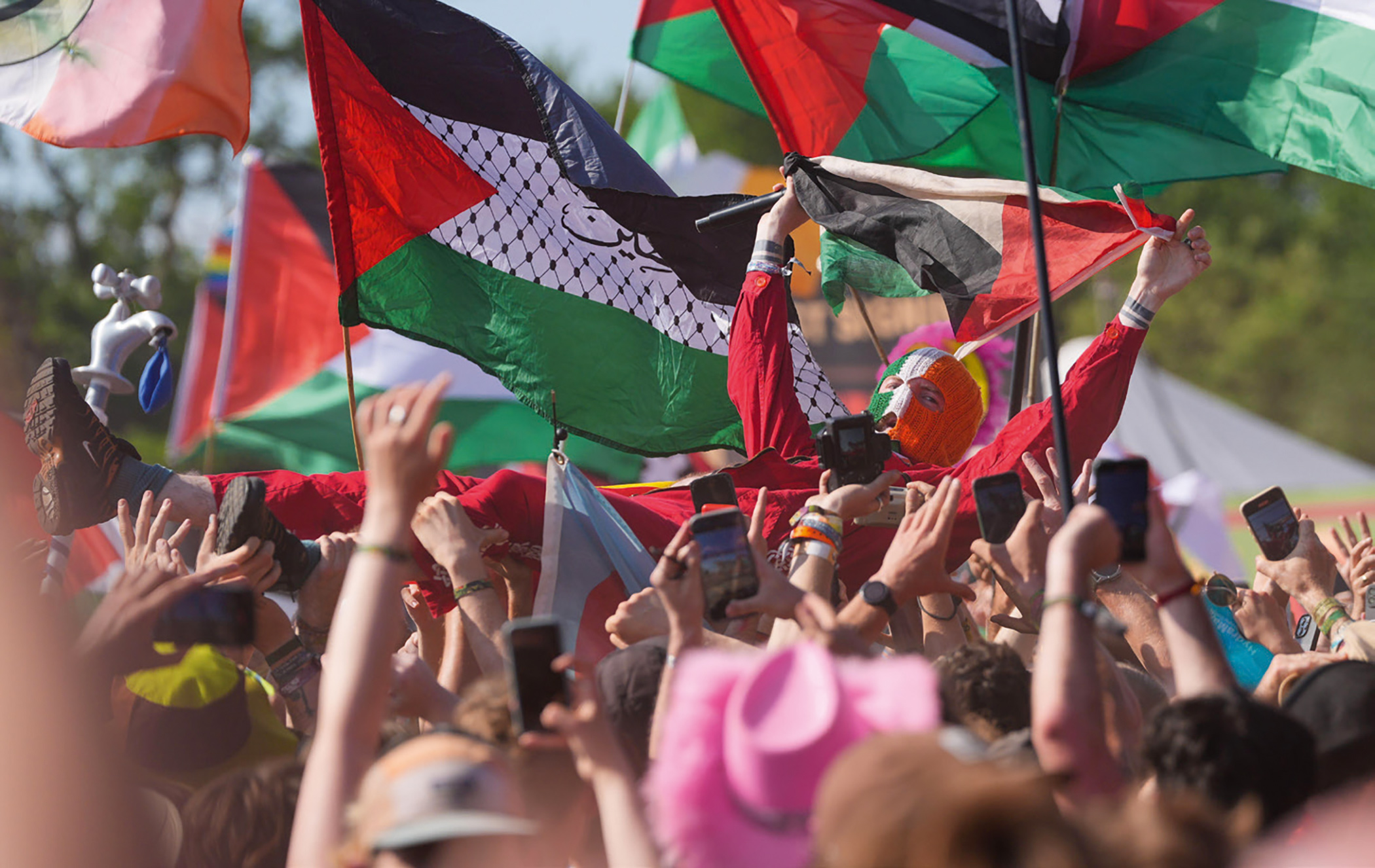
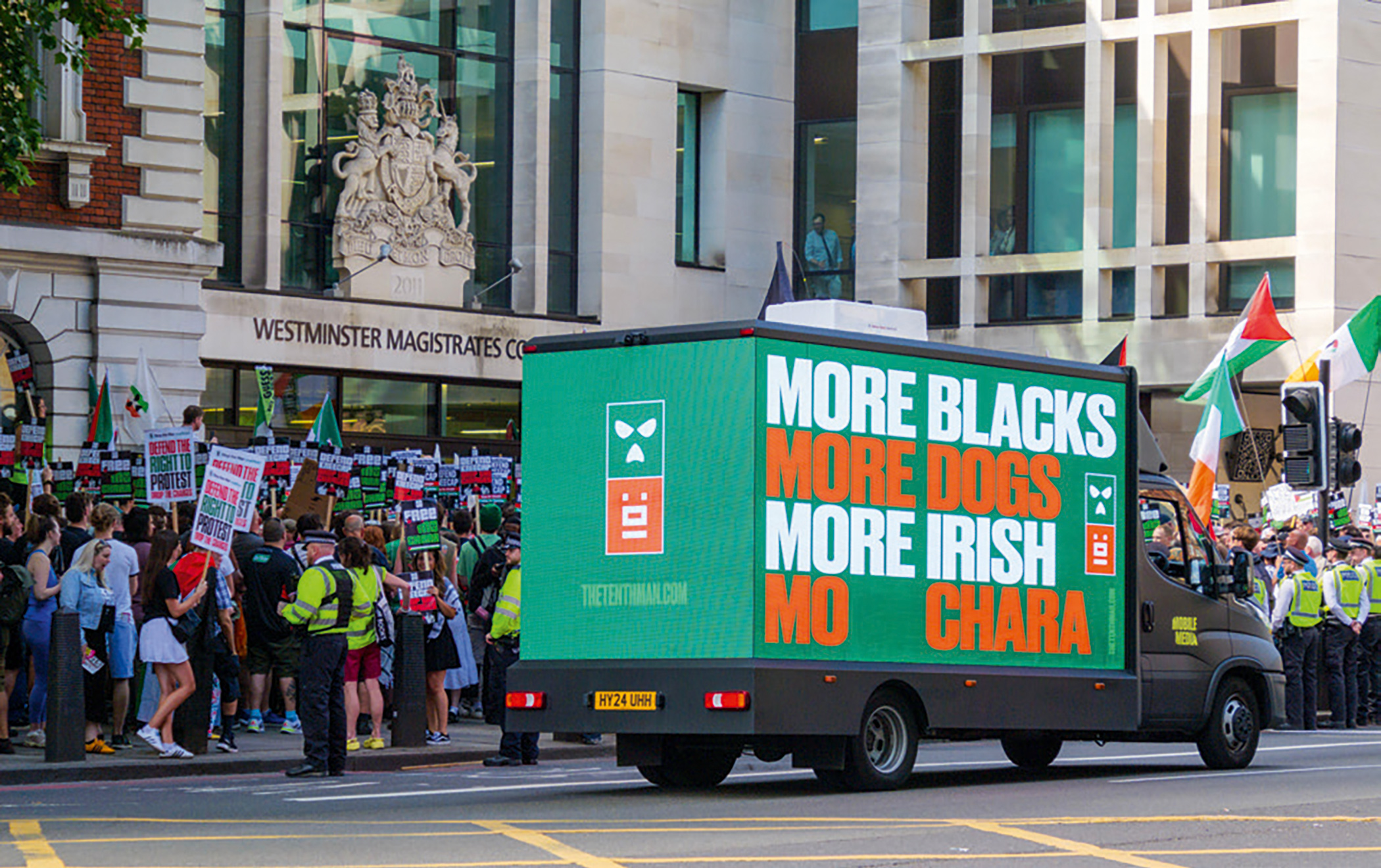
On an unseasonably warm day in June, hundreds of people holding Palestinian and Irish flags spilled over the sidewalks outside Westminster Magistrates Court in central London. The crowd had gathered in support of Liam Óg Ó hAnnaidh, the 27-year-old member of Irish-language hip-hop group Kneecap charged by the British government with a terror offence for holding up a flag from the Lebanese militant group Hezbollah at a concert last year.
Regular court reporters said they’d never seen crowds like it, even when Julian Assange was on trial.1 Among the throngs were some high profile supporters from the worlds of music and politics: musician Paul Weller and filmmaker Jim Sheridan rubbed shoulders with Sinn Féin Westminster MPs John Finucane and Paul Maskey.
Inside the court, an even more profound moment was taking place. Ó hAnnaidh, who performs under the stage name ‘Mo Chara’ (Irish for ‘my friend’), sat alone in the dock before an English magistrate as pro-Palestine chants echoed from the streets outside.
For anyone with knowledge of the history of Irish republicanism, the sight of a young Irish man facing down the British justice system for a terrorism charge holds profound significance.
The British government has failed miserably, time and again, to understand the joke that is being played at its expense
But, unlike the republicans of the 1970s, Ó hAnnaidh did not turn his back on the judge or refuse to recognize the court. Instead, his time in court and on bail has given Ó hAnnaidh a different kind of stage to the one he’s used to, providing the chance to make the case about his band’s outspoken support for Palestinian freedom, and to further Kneecap’s trolling of the British establishment. To this end his high-powered lawyers requested something radical: that court proceedings continue with an Irish interpreter.2
The magistrate told Ó hAnnaidh’s lawyers that the court had so far been unable to find one, the Irish Times reported.3 ‘If you know of an English to Irish interpreter, then please let us know,’ the magistrate told the defence. Giggles erupted in the public gallery, where supporters pointed at Ó hAnnaidh’s bandmate JJ Ó Dochartaigh, who was formerly an Irish teacher and now performs as ‘DJ Provai’. In Kneecap, the feature-length (though fictionalized) biopic of the band, Ó Dochartaigh is introduced to the band’s other member, Naoise ÓCairealláin, known as Móglaí Bap on stage, when he demands an Irish interpreter in a police interview. This was life imitating art.
The magistrate promised to locate an Irish interpreter for future hearings, and Ó hAnnaidh was released on bail, just in time to play Glastonbury Festival. This scene sums up the contradictory threads at play here: Kneecap are a satirical band who mostly rap about taking drugs and getting into trouble with the police for misdemeanours. They’ve described their on stage personas as ‘exaggerated’ characters. Yet the British government has failed miserably, time and again, to understand the joke that is being played at its expense.
On their knees
Kneecap are named after the dissident republican practice of shooting suspected drug dealers in the knees. Not because, as some of their more myopic critics suggest, they celebrate the punishment – but because as three lads who rap about taking drugs, they’d be first in line for a bullet. It’s easy not to get the reference if you know nothing about Kneecap’s context, which many of their British critics clearly don’t. But understanding the context from which they emerge – in terms of language politics, the political policing of ‘terrorism’ and the symbolic power of flags and symbols – is essential to understanding the importance of this case.
In Kneecap, which became the first Irish-language film to appear at Sundance, the band play themselves being pursued by dissident republicans, portrayed as hapless idiots. Under the influence of ketamine, one band member hallucinates Gerry Adams – played by the man himself. Kneecap’s relationship with traditional republicanism is tongue-in-cheek to say the least.
But they are deadly serious about a few things: taking a consistent anti-imperialist stance against the British government, and their support for Palestinian liberation. And the legal proceedings against them have given them the opportunity to amplify their message. Since their appearance at Coachella and the scandal that followed, the band and their supporters have firmly repeated the line that ‘Kneecap is not the story, genocide in Gaza is’. This is a worthy attempt to reframe the conversation, and the charge against Ó hAnnaidh is a perfect encapsulation of the ‘Palestine exception’ to free speech.
But it’s also part of parallel history: the enduring relevance of Irish history of resistance through language, and the suppression of dissent. As ÓCairealláin told a crowd of thousands from the stage at Glastonbury: ‘It’s not the first time there was a miscarriage of justice for an Irish person in the British justice system.’
The charges may be a farce, but they reveal something far more serious. That is, the unequal use of terrorism laws to police political protest in Britain and Northern Ireland, and the government’s refusal to speak out against ongoing genocide being conducted by Israel against the Palestinians, something the vast majority of UK voters want to see end.4 It’s clear the British state has opened a Pandora’s box that will be hard for them to close.
Kneecap are not the republican bogey-men of the Troubles – unlike Adams, whose voice was dubbed when his statements appeared on the BBC from 1988 to 1994.5 Kneecap are something else entirely: social media savvy political actors engaged in the kind of tongue-in-cheek cultural insurgency against the British establishment that speaks to young people across traditional divides. And that’s why they truly pose a threat.
State-sponsored famine
Kneecap are perhaps best known for their pioneering use of the Irish language in their music and acting. Language is never neutral – as radical educator Paulo Freire famously argued – but perhaps nowhere is that more true than in Northern Ireland.6 Even the name you choose to use for the six counties of the eight that made up the historic Irish province of Ulster is to take a position. Some republicans and supporters of Irish unification, like Kneecap, are more likely to call it the ‘north of Ireland’ or the ‘six counties’. For some loyalists, and those who favour continuation of British rule, it is still – and exclusively – ‘Ulster’.
Irish is a Celtic language far older than English, emerging in Ireland around 300 BCE. Monks wrote poems and phrases in Irish in the margins of the Book of Kells – the Latin language manuscript of the four gospels – more than 1,200 years ago. The Anglo-Norman conquest of Ireland introduced Norman-French and English, but it was confined to the ‘Pale’, an area around Dublin. Beyond the pale, Irish continued to thrive.
In 1367, the Statute of Kilkenny became the first British law passed in Ireland that banned the use of Irish.7 It became illegal for English colonists to learn or speak Irish, use an Irish name or adopt Irish children, all punishable by death.
It was the Tudor conquests of the 16th century and the plantations that followed, with their violent land confiscation and forcible ‘anglicization’ of the Gaelic aristocracy, that began to starve the language. Irish was actively outlawed and discouraged as the entire legal, economic and political administration of the state shifted into English.
The language fell into a long decline that was worsened by an Gorta Mór, the state-sponsored famine of 1845 to 1853 which killed a million people, many of them in the southern and western areas where Irish had survived. This was followed by eviction and mass migration of many remaining Irish speakers.
It must have seemed likely that Irish would be consigned to history’s long list of dead – or murdered – languages. However, the Gaelic Revival movement of the 19th century led to a resurgence of interest in not only language but Irish music, customs, folklore and sports as part of a wider nationalist renaissance. Leaders of the revival movement included Pádraig Mac Piarais (Patrick Pearse), who would later be murdered by a British firing squad for his role in the Easter Rising of 1916. It was Pearse who famously said: ‘Tír gan teanga, tír gan anam.’ (A country without a language is a country without a soul.)
Despite the best efforts of revivalists, Irish still carried a social stigma, with many parents actively discouraging their children from speaking in the language. In 19th century Irish schools, children faced the prospect of the bata scoir, a tally stick tied around their necks with string, on which teachers would cut a notch each time the child spoke Irish. At the end of the day, they’d be punished according to how many notches were on their stick.
Unsurprisingly, the courtroom has long been a battleground over the use of the Irish language. In 1737 the Irish parliament passed a statute forbidding use of Irish in the courtroom and imposing a fine for each time it was spoken. This led to miscarriages of justice, such as the 1882 Maamtrasna Murders trial on the border of Mayo and Galway which saw three of the eight Irish speakers condemned to death by hanging. They did not speak any English, could not pronounce the plea ‘not guilty’, their solicitor spoke no Irish, and their evidence was translated into English by a police officer. One man, Maolra Seoige, asked as the noose was being fastened around his neck: ‘Cia’n fá mé chur ann báis?’ (‘Why should I be put to death?’). He was posthumously pardoned in 2018.
Nothing neutral
Following the establishment of the Irish Free State in 1921, the new Irish government officially recognized the Gaeltacht, or Irish-speaking areas of the country, and took steps to protect the language. For those in the six counties that became Northern Ireland, still part of Britain, the language was left without any institutional support.
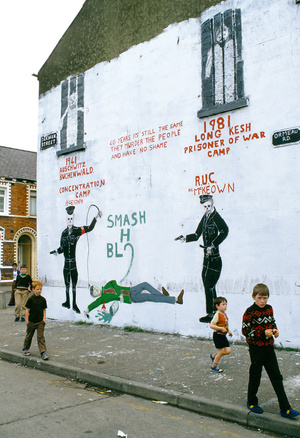
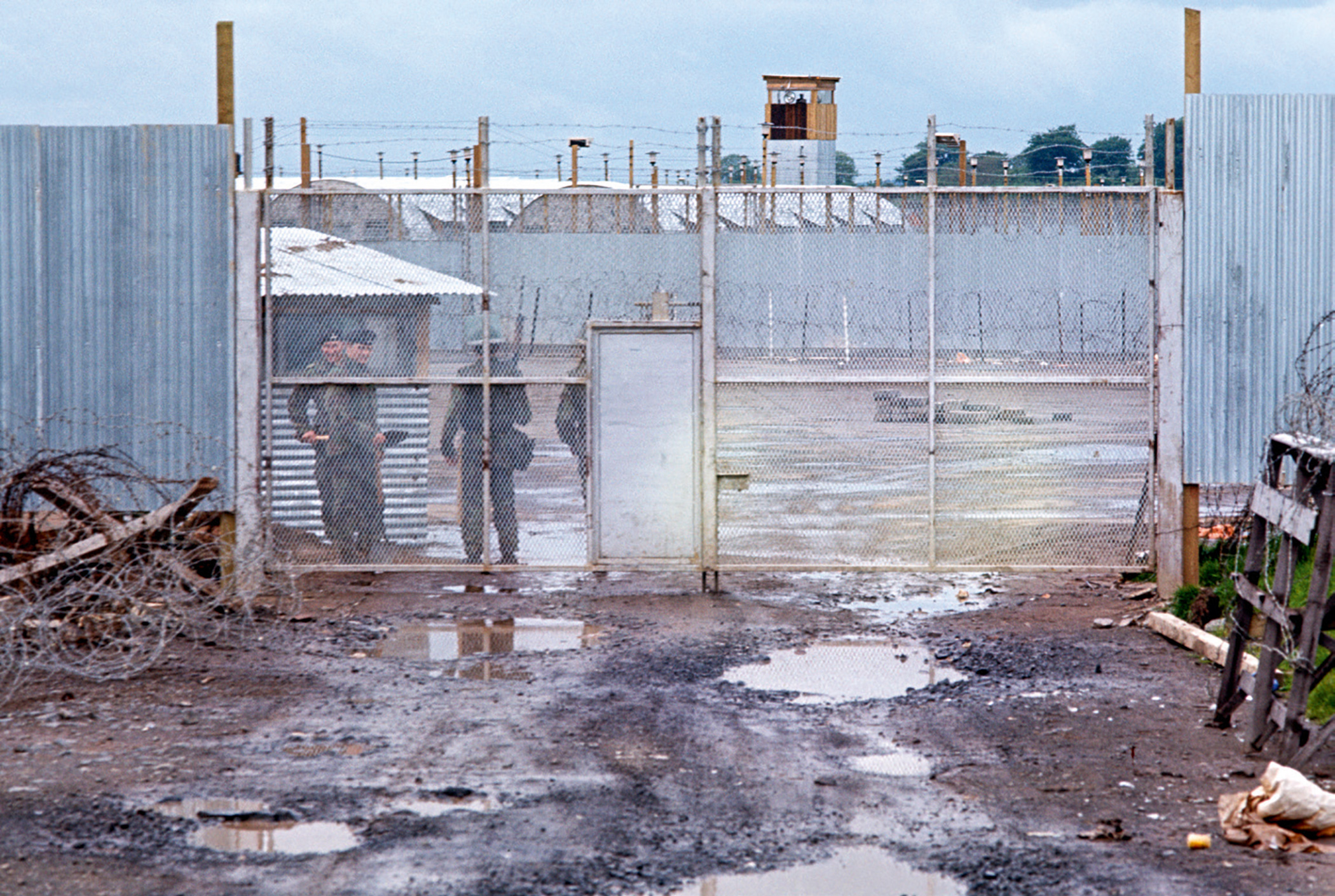
Irish became increasingly significant to the republican movement throughout the Troubles. During the 1970s and 1980s, members of republican groups interned by the British in the infamous Long Kesh prison – or HMP Maze – learned Irish as a form of communication their guards could not understand. The cells became an Irish-language university, giving rise to ‘Jailtacht’, a version of the language spoken among prisoners and ex-prisoners.
In urban areas, the language was kept alive by generations of dedicated language activists, among them Gearóid
Ó Cairealláin, an Irish-language journalist and performer and the late father of Kneecap member Liam Ó Cairealláin. It was in Kneecap’s home of west Belfast that a group of families first set up a co-operative housing project that aimed to become the first urban Gaeltacht in 1969.8 Today west Belfast’s Gaeltacht Quarter is home to Irish language schools, sport teams, theatre, social centres, pubs and festivals. It is this context from which the band emerge.
There can be nothing neutral about a language that has survived and been carried through such a violent historical context. The fight over language rights has led to years of political deadlock in Stormont, with parties on each side of the issue using it as a stick to beat the other.
A more cynical view of republican political party Sinn Féin’s support of language rights – such as their years-long push for an Irish Language Act that would give the language an equal status with English in Northern Ireland – suggests that the issue has been used to stoke their base while selling out on any kind of radical economic agenda that would truly address the issues Kneecap highlight across northern Irish communities: poverty, housing and mental health. Equally, the lack of a political solution to these issues means there’s a danger that any language-based political movements could attract more xenophobic and ultra-nationalist elements of the kind that fuelled anti-immigrant incidents in both the Republic and Northern Ireland over the last year.9,10
Kneecap themselves have consistently pushed back against narrow conceptions of Irish and who the language belongs to. ‘Language isn’t one philosophy or one ideology, language is a wide spectrum of people speaking it and that’s the way it should be,’ Ó Cairealláin said last year.11 ‘Nobody can gate-keep language. Nobody can say what way you should speak it, or who should speak it. Anybody can speak it.’
The law against the use of Irish in Northern Ireland’s courts was only repealed in March this year.
One man’s terrorist
Seeing Ó hAnnaidh in court, it’s impossible for anyone with a knowledge of history not to be reminded of the recent history of unjust convictions against young northern Irish men in British courts.
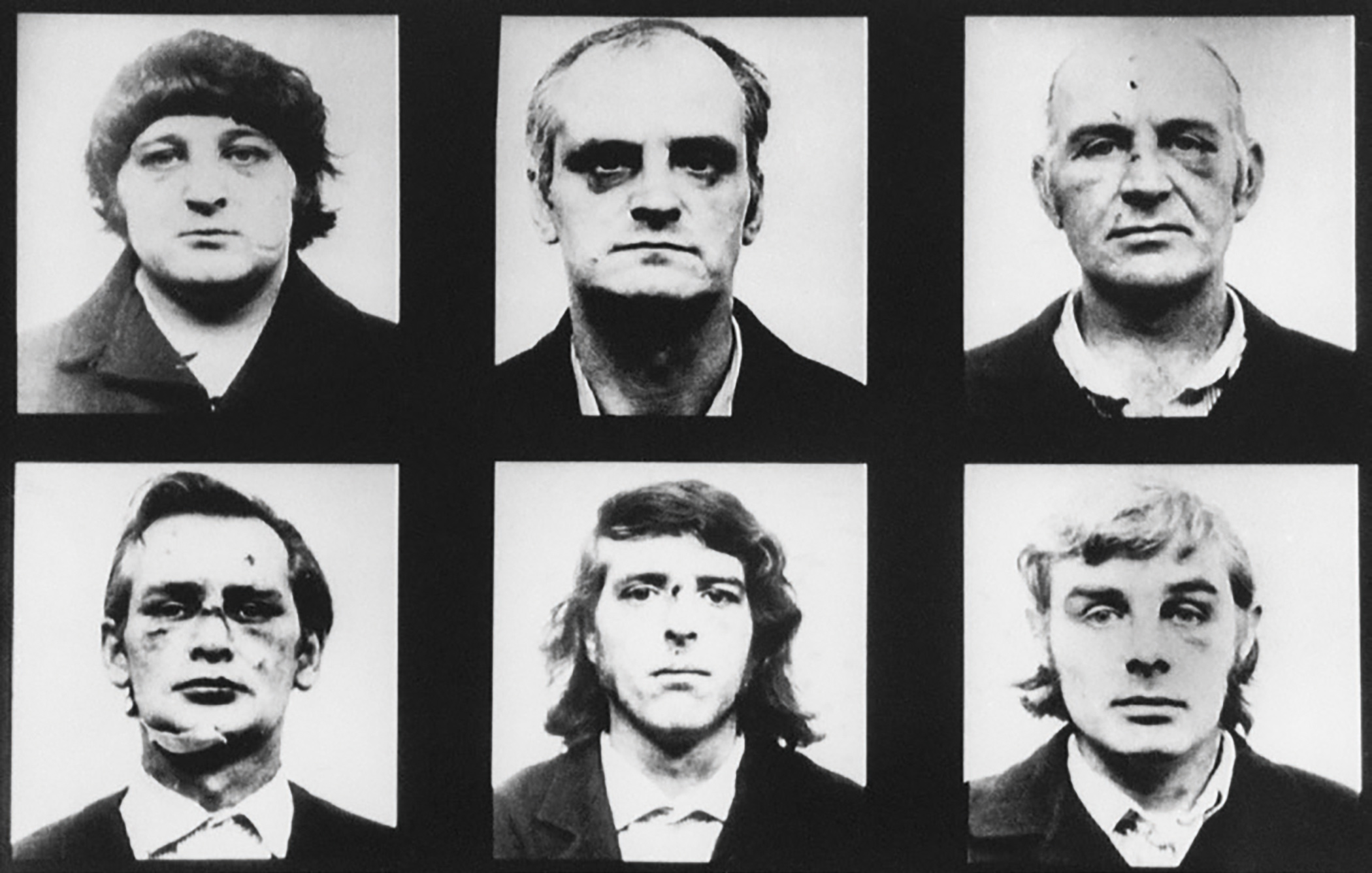
Those like the Birmingham Six, a group of northern Irish men sentenced to life imprisonment in 1975 for a set of bombings attributed to the Provisional Irish Republican Army. The convictions were overturned in 1991, when England’s court of appeal found the police had fabricated and suppressed evidence. The men said they were beaten in police custody and interrogated for 12 hours at a time.
It also brings to mind the Guildford Four and Maguire Seven, two groups of mostly young northern Irish men and women convicted in the same year as the Birmingham Six, also accused of carrying out bombings on the British mainland. They said they gave false confessions after brutal police interrogations. Those convictions were also later overturned, but not before one man, Giuseppe Conlon, died in prison. None of those responsible for these false convictions have been held accountable. Many of the judges and investigators involved were in fact promoted, and continued to serve in Britain’s criminal justice system.
Repressive policies enacted in their colonies will eventually find their way home
The ‘imperial boomerang’, a concept first articulated by anti-colonial theorist Aimé Césaire, suggests that repressive policies and atrocities enacted by a government on their colonies will eventually find their way home, to be used against their own people. The British Empire, whose first colony was its neighbour Ireland, has long had a convenient testing ground for its more brutal methods of counter-insurgency.
It was in Northern Ireland that the British developed the ‘five techniques’ of interrogation – today widely understood to be torture. These were first used in 1971 as part of Operation Demetrius, the mass arrest and internment of men accused of involvement with the Provisional IRA. Fourteen of them, who later became known as the ‘Hooded Men’, say they were subjected to all five ‘techniques’ while in custody. They describe having their heads covered at all times with a hood, being subject to beatings, stress positions and noise torture, and being deprived of food, drink and sleep. This extreme use of torture against Irish internees was sanctioned at the highest levels of the British government.12
These ‘advanced interrogation’ methods helped shape the torture playbook used by the US in Abu Ghraib and Guantanamo Bay, and similar methods have been detailed by Palestinian prisoners held by the Israeli government without charge since the beginning of the current genocide in Gaza.12 The Hooded Men have still not seen justice for their ordeal.
Unlike Kneecap, the British government does not have a sense of humour about itself or its history. Britain has long misused terrorism laws on its own soil against Irish republicans while conveniently overlooking the crimes of loyalists, which it saw as useful, if unpleasant, allies in its attempts to pacify the North. We can draw a line through history from this policing of internal dissent against British colonial interests to today’s ludicrous use of terrorism law to proscribe direct action group Palestine Action.
Whilst terrorism charges were levelled against Ó hAnnaidh in late June, the government simultaneously targeted Palestine Action, whose activists have staged occupations of an Elbit Systems-owned drone factory in Leicester, spray painted ‘Free Palestine’ on the British head office of weapons company Leonardo SpA in Piccadilly and broken into Brize Norton, an RAF air base in Oxfordshire, on e-scooters, spraying red paint into the engines of two planes.
It was this final embarrassing event – should it be that easy to break into an RAF base?– that seems to have prompted Britain’s Home Secretary Yvette Cooper to ban the group under the Terrorism Act. Being a member of Palestine Action is now punishable by up to 14 years in prison. Expressing support for the group is also illegal.
The case brings to mind the Fairford Five, who in 2003 broke into an RAF base in Gloucestershire and damaged planes in protest against British involvement in the Iraq war. In court it was argued that, because the activists aimed to prevent greater crimes caused by the war, their criminal actions were morally and legally justified. Among the barristers behind this defence was young human rights lawyer Keir Starmer. Now knighted for his services to the Establishment, he is overseeing the repression of Palestine Action – against everything he might have once defended.13
This is more than a man caught in the machinations of maintaining power. It’s the kind of pure hypocrisy that critics of the British government like Kneecap have been calling out all along.
Flags and emblems
The charges against Ó hAnnaidh focus on the allegation that he held up the flag of Hezbollah – itself a prescribed terrorist group under British law – and chanted ‘up Hamas, up Hezbollah’ at a concert in north London last November. Footage of the alleged incident was unearthed on social media by pro-Israel groups following Kneecap’s unapologetic and out-spoken support for Palestinian human rights on the global stage at Coachella festival in the US. Kneecap denied the allegations, writing in a statement that they ‘do not, have never, supported Hamas or Hezbollah,’ and calling the charges an attempt to ‘manufacture moral hysteria’.14
A separate terror charge, relating to footage that appeared to show a band member saying ‘Kill your local MP’ and ‘the only good Tory is a dead Tory’ – a reference to the pet name for Britain’s right-wing Conservative Party – at a 2023 gig, has now been dropped due to being outside the statutory time limit for prosecution.
While such comments may be distasteful, especially given the recent assassinations of Labour and Conservative MPs Jo Cox and David Amess, this kind of trigger-happy prosecution is laughable given the political history of British culture. Perhaps under today’s circumstances members of the Sex Pistols and Siouxsie and the Banshees would have been prosecuted for wearing swastika imagery on stage, or the publishers of 1990s British anarchist newspaper Class War would have been jailed for their cartoons depicting former British Prime Minister Margaret Thatcher being hanged.15,16 Incidentally, one senior Tory called for a police investigation into bestselling writer Hilary Mantel after she published a story called The Assassination of Margaret Thatcher in 2014, a year after the ex-PM’s death from natural causes – but he was, of course, ignored.17
That a flag is at the centre of the charges against Ó hAnnaidh seems particularly significant given the band’s origins in west Belfast. Battles over flags in Northern Ireland have for decades been a proxy for sectarian divides and complex community allegiances. A 1954 law ordered the Royal Ulster Constabulary (RUC) to remove any ‘emblem’ likely to lead to a ‘breach of the peace’. The Union Jack was, of course, exempt. The Irish tricolour flag was the police’s main target. In 1964, RUC officers beat up republican protesters in the streets of west Belfast as they removed an Irish flag from a local campaign office in what became known as the Tricolour Riots.18 The Act was repealed only in 1987.
The past is not dead in Ireland – it isn’t even past
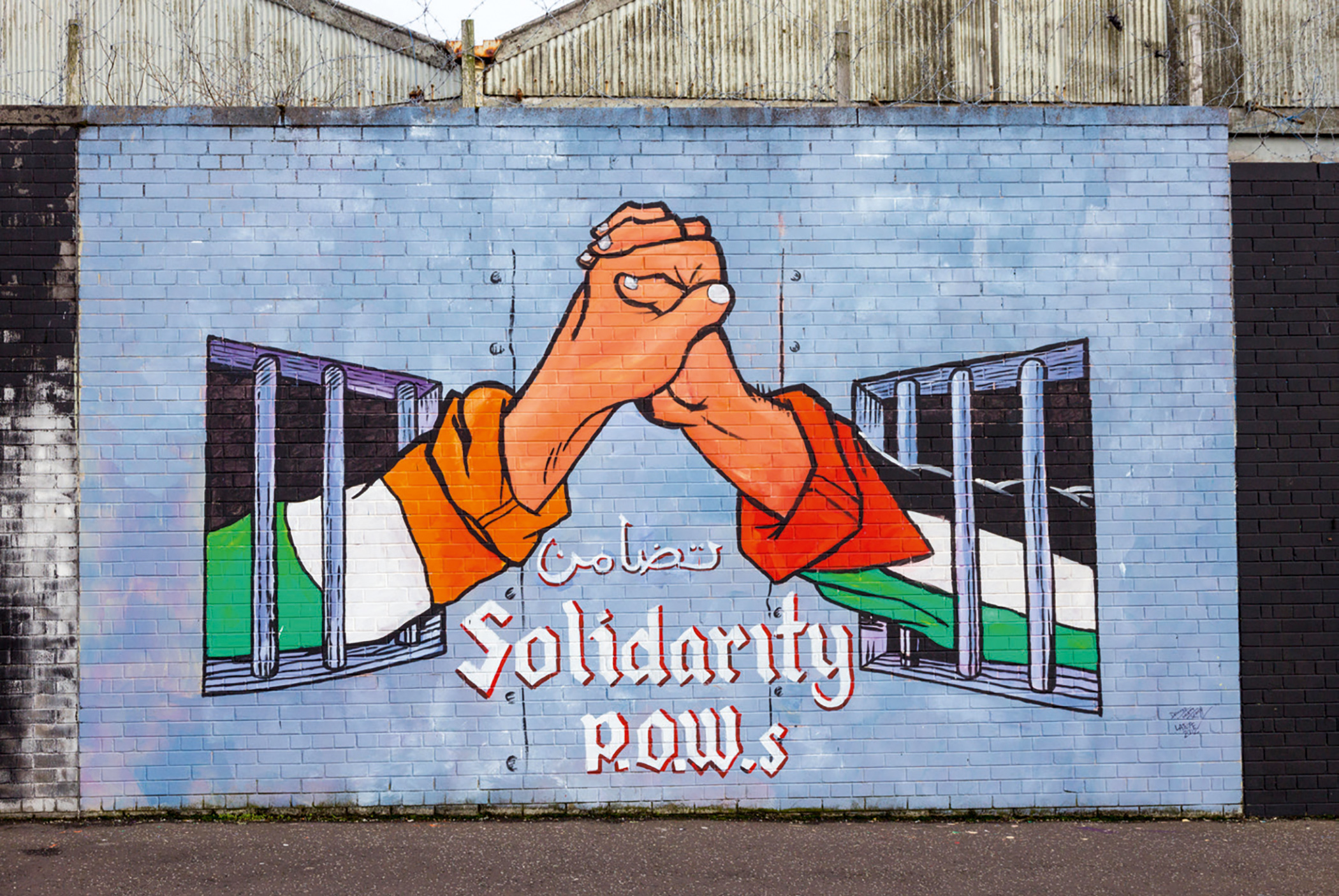
Flags have remained a live political issue even since the Good Friday Agreement, with republican areas in west Belfast continuing to fly the tricolour alongside Cuban and Palestinian flags. In loyalist neighbourhoods the Ulster Banners flutters alongside Israeli flags and, most significantly, the flags of a number of ‘proscribed’ terrorist groups, such as the Ulster Defence Association (UDA), and the Ulster Volunteer Force (UVF), loyalist paramilitaries who carried out extrajudicial murders of Catholics with the explicit support of the British government. The same government are now bent on prosecuting Ó hAnnaidh for holding up a flag passed to him by a crowd member at a gig. Such irony appears to be lost on British politicians who should know better.
This is the political context that birthed Kneecap. The Troubles are not an abstract concept to them, even though they are ‘ceasefire babies’ who grew up in the shadow of the peace process. The past is not dead in Ireland, to paraphrase Willian Faulkner – it isn’t even past. While the band may refer to themselves as ‘republican hoods’ and their fans as ‘Fenians’ – in both cases repurposing slurs that have been used against Irish Catholics– their relationship to the history of nationalism is complex.
Class not country?
‘The republicans we know are all the binmen and teachers in our schools, and barmen,’ ÓCairealláin told Vice in 2022.19 ‘These people who were poor working-class people who wanted to join a cause. We can’t look back at that time and question the options they chose.’ In the same interview, he emphasized his belief that there was no longer a place for violence in the modern-day movement for Irish rights, and they’d rather focus on fostering a vibrant Irish language culture and building bridges across the working-class communities – Catholic and Protestant – of the north of Ireland.
‘I’ve more in common with Joe Bloggs from the Shankill Road, who’s 23, than Sebastian Cockworth from Dublin,’
Ó hAnnaidh said in 2021.20 ‘Even though we’ve both got the same passport, I’ve more in common with a working-class unionist than an upper class Irish person.’ Last year, DJ Próvaí said that the project’s aim is not to stoke community tensions, but ‘it’s about deconstructing the systems that have created all this poverty, sectarianism, hatred and murder’.21 And although much has been said about their innovative use of Irish, many of Kneecap’s most popular songs have a refrain or partial chorus in English, rendering their music accessible to audiences across Britain, Ireland and beyond.
And they’ve put their money where their mouth is. In 2024 then Conservative business secretary Kemi Badenoch blocked a £14,250 ($9,270) arts grant that Kneecap had been awarded. A spokesperson for Badenoch told the press the money should not be given ‘to people [who] oppose the United Kingdom itself’. Kneecap took Badenoch to court and won, with a judge concluding the withholding of funding was ‘unlawful’. The band donated the money to two youth organizations who work in both Protestant and Catholic communities in Belfast.
Some in the British press have accused Kneecap of manufacturing outrage to sell more concert tickets, but the band’s outspoken support for Palestinian human rights predates their fame. The group has a longstanding relationship with the Aida refugee camp in the West Bank. For at least the last five years, they’ve raised money to help build gym and sports facilities for youth living in the camp.
Kneecap are not republicans in the traditional sense, even if the British establishment might prefer it if they were. Instead, they emerge from a different time, and have been shaped by a post-ceasefire context. If anything, their anti-authoritarian, anti-imperialist, socialist conception of the world is more threatening to the British government of today than any IRA splinter group.
There’s been a surge of interest in learning the Irish language among young people, a trend dubbed the ‘Kneecap effect’.22 But in Kneecap’s world, the Irish language is not a political end in itself. It’s about carving out a culture inspired by Irish radicalism and waging an anti-colonial insurgency against the values and ideals of the British establishment. When Kneecap demand that ‘England get out of Ireland’ they don’t just mean removing the infrastructure of the British state. It’s also about decolonizing the Irish imagination. The language is not simply a return, a way to access histories of Irish indigeneity and resistance, but also a departure, a place from which to find common cause with communities around the world.
By placing the Irish experience of British colonialism in an internationalist context it links them to other struggles, to Palestinians under Israeli bombs for example, creating networks of solidarity that resonate with young people across the world, even those who don’t speak a single word of Irish.
- Mark Paul, ’Kneecap case…’, Irish Times, 18 June 2025, a.nin.tl/Magistrate
- Christophe Domec, ‘The Kneecap Trial Exposed Britain’s Free Speech Crisis’, 20 June 2025, a.nin.tl/KneecapTrial
- Jake Fitzpatrick, ‘Kneecap Turn Courtroom into Comedy…’, Blunt, 19 June 2025, a.nin.tl/Provai
- ‘UK attitudes toward the conflict in Israel and Gaza’, Ipsos, 4 October 2024, a.nin.tl/Ipsos
- Séamas O’Reilly, ‘“Counterproductive and silly”…’, The Guardian, 15 September 2024, a.nin.tl/VoiceBan
- ‘Paulo Freire: Education for Social Change’, Freire Institute, a.nin.tl/Freire
- ‘On this day in 1367…’, Irish Post, 19 April 2021, a.nin.tl/Kilkenny
- Robbie Meredith, ‘The Irish-language history hidden in Belfast’s attics’, BBC News, 11 November 2024, a.nin.tl/Attics
- Finn McRedmond, ‘Ireland’s anti-immigrant rage will not go away’, New Statesman, 11 June 2025, a.nin.tl/Rage
- Eve Rosato, ’Anti-immigration protest and counter rally gather at city hall’, BBC News,25 March 2025, a.nin.tl/Belfast
- Solomon Pace-McCarrick, ’Kneecap: “Life in Belfast…”’, Dazed & Confused, 28 August 2024, a.nin.tl/Dazed
- Mark Hennessy, ‘British ministers sanctioned torture of NI internees’, 5 June 2014, a.nin.tl/Internees
- Alan Rusbridger, ‘Keir Starmer used to stand up for the kinds of protesters he now labels terrorists’, The Independent, 27 June 2025, a.nin.tl/FairfordFive
- Kneecap, ’KNEECAP STATEMENT’, X, 28 April 2025, a.nin.tl/Statement
- ‘Strange things artists have worn on stage and the reasons why’, BBC, 14 March 2018, a.nin.tl/Banshees
- ‘How’s this for a ten year stretch?’, Class War, No 33, c.1987 a.nin.tl/ClassWar
- Damian Barr, ‘In defence of Hilary Mantel’s Thatcher story – and fiction’, The Guardian, 22 September 2014, a.nin.tl/Mantel
- Andrew Boyd, Holy War in Belfast, Anvil Books, 1969, a.nin.tl/HolyWar
- ‘Kneecap on VICE’, YouTube, 30 May 2025, a.nin.tl/VICE
- KNEECAP, ‘We’ve more in common…’, X, 24 August 2023, a.nin.tl/Bloggs
- John Blistein, ‘Kneecap want to piss off the world – and unite it’, Rolling Stone, 20 February 2024, a.nin.tl/RollingStone
- Éanna Ó Caollaí, ’“It’s getting a bit sexy”…’, Irish Times, a.nin.tl/Sexy
