
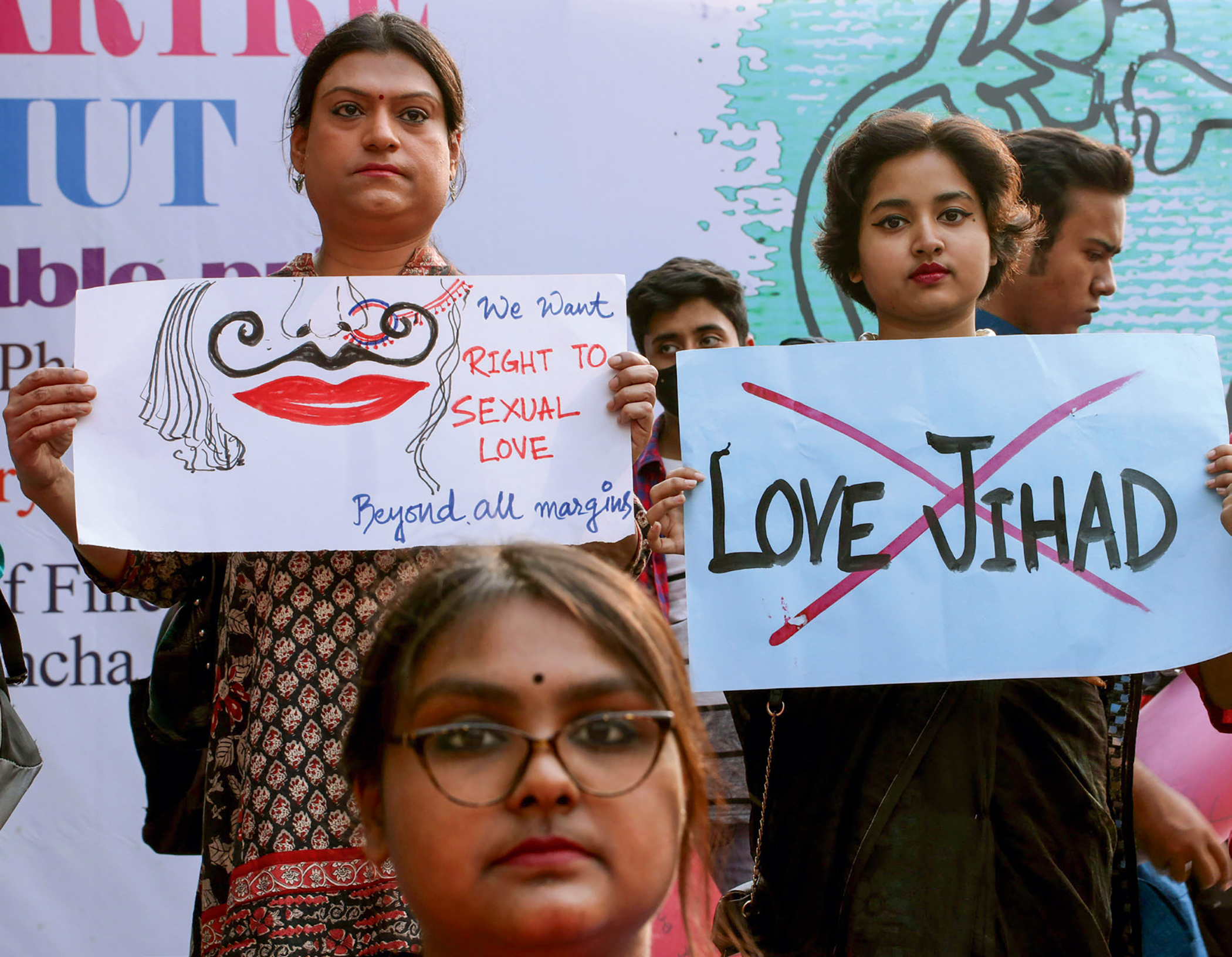
‘We decided to get married in 2022, when Aatish and I revealed our relationship to our parents, but it took us three years to reach here,’ says 25-year-old Rekha. The couple finally got married in May, after eight years together, but the romance of the wedding was robbed by the struggle to gain the approval of friends and family. Aatish is Muslim, Rekha is a Hindu – and nobody supported the interfaith marriage.
The pair met in 2017, when they were just 17, at a tuition centre in New Delhi while they were preparing for their final school exams. Rekha was a well-behaved student, unlike Aatish, who was a mischief-maker in class. But despite their differences they became good friends. ‘We didn’t call each other “girlfriend” or “boyfriend” for two, three years at the start but we knew that we had chosen each other for life,’ Aatish says. During that period they never met for longer than a few hours outside of class so that they could hide the relationship from their families until the time was right.
However, neither of them anticipated the backlash they would face. ‘We never felt the differences in our religions to be significant because in my family, my father has always had Muslim friends,’ Rekha says. ‘I was shocked when he disapproved of my relationship so strongly.’ He even threatened, she says, to go to members of the Bajrang Dal, a far-right militant group notorious for its violence against interfaith couples, if she didn’t leave Aatish. ‘But it didn’t deter me,’ Rekha added. It wasn’t just her family – her friends abandoned her too when she requested them to be witnesses to the marriage. ‘I felt a sense of betrayal from everyone, but Aatish supported me a lot.’
Whipped up
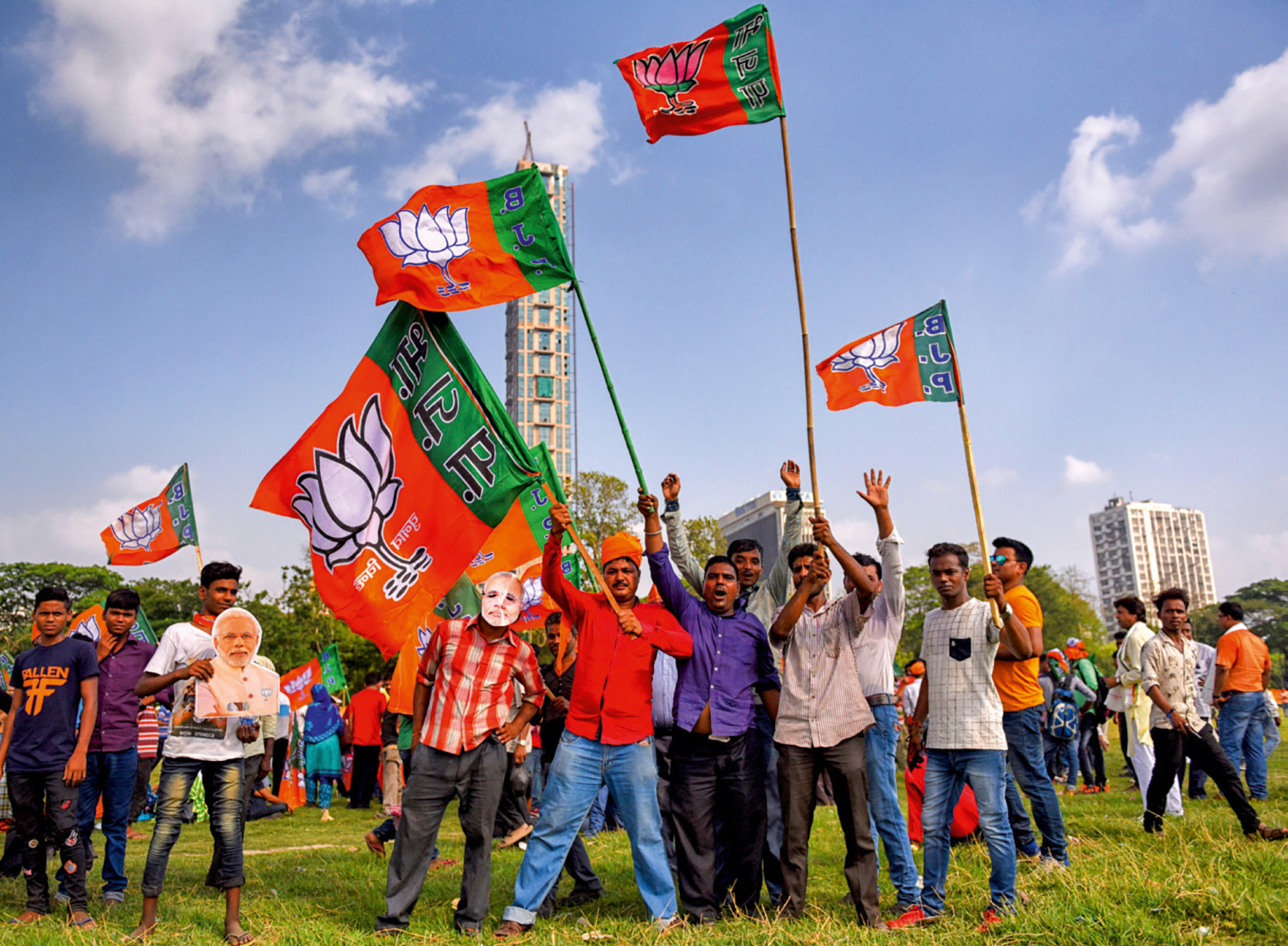
In Narendra Modi and his ruling Bharatiya Janata Party (BJP)’s India, where Hindu majoritarianism has become both mainstream and militant, the declaration of an interfaith relationship – between a Hindu woman and a Muslim man – is as bold as it is dangerous. Aatish and Rekha chose these pseudonyms for themselves out of concern for their safety if their identities become disclosed.
At the heart of the opposition to interfaith relationships is the paranoia of a Hindu majority concerned about demographic change and religious conversions. Hindus constitute almost 80 per cent of the Indian population, whereas Muslims comprise just 14 per cent.1 Despite the fact that freedom of religion is enshrined in India's Constitution as a fundamental right, conversion is rarely viewed as a wilful choice, especially when it concerns conversion from Hinduism.
As a result, even though many interfaith couples choose to marry under the secular Special Marriage Act (SMA), without any religious conversion, the Hindu far right has created and successfully propagated the myth of a ‘love jihad’. It refers to the widely believed conspiracy that Muslim men are plotting to seduce and lure Hindu women under false pretences and ultimately bring them into the Islamic fold through conversion. During Modi’s tenure, 11 different states have enacted or updated anti-conversion laws, and three others have proposed it.2 A 2021 Pew Research Center survey of 30,000 Indians across the country found that around 65 per cent believed it was very important to stop interreligious marriages.3
This discrimination results in very real consequences, ranging from harassment, to criminal persecution, to deadly mob violence.4 And the idea is supported by members of the ruling BJP itself, including by the union home minister, Amit Shah, as well as chief ministers of multiple states where the party is in power.5 Threats from the Bajrang Dal and other far-right groups, are widespread, with reports of vigilantes even threatening kill Muslim men, and destroy their businesses and homes.6
The right to choose
After completing his graduation, Aatish moved to the eastern state of West Bengal to set up a cashew business in 2021. With Aatish out of state, Rekha was left with the work of organizing their marriage alone. Under the SMA, a couple must declare their intention to marry, following which their names, addresses and photographs are posted on a noticeboard in the local government office, inviting any objections to the union. This information then often circulates among rightwing networks, triggering the attention and intervention of extremist groups.
Rekha recalls the palpable tension every time she approached lawyers in Delhi’s courts. ‘As soon as I’d tell the advocates that we are a Hindu-Muslim couple, they would start talking to me with contempt,’ she explains. ‘It was extremely demotivating when the advocates refused to help me, or told me plainly that a marriage like mine is impossible to conduct, especially when we strictly wanted to register our marriage under the SMA without converting to each other’s religion.’
But not everyone was against Aatish and Rekha’s union. After researching for help online, Rekha found Dhanak, an organization that provides invaluable support, shelter and guidance for interfaith couples. It was founded in 2004 by Asif Iqbal and Ranu Kulshreshtha, themselves an interfaith couple, as a support group focused on the right to choose in matters of relationships and marriage.
‘I told Aatish, but we were both quite sceptical in the beginning,’ Rekha says. ‘After talking to Asif, we were convinced.’ Finally, on 30 May this year, the couple registered their marriage in Delhi, with members of Dhanak in attendance.
Initially a small group, Dhanak has grown over the years, and as of March 2025 has provided support to 2,780 couples.7 Of the women who contacted the group, 71 per cent were Hindu. The organization is one of a few groups that offer support to courageous couples who choose to pursue their proscribed love, and in doing so resist the violent campaign led by Hindutva extremists – people who follow a far-right Hindu nationalism – to keep interfaith couples apart.
Dhanak offers varying kinds of support. This includes socio-legal counselling, providing emergency housing to runaway couples, offering mediation between couples and the police or their families, and even helping them find a job and pay rent.
Legal heroes
One of the most urgent forms of support that couples require is legal assistance, to help them register their marriage in court, and to seek judicial intervention directing police protection from threats of violence. However, as Rekha learnt, it can be difficult to find advocates who can be trusted. Lawyers and court staff have been known to harass or attack interfaith couples, or they may tip off Hindu extremists about the union.6
Choosing to represent a cross-community couple in court can also be a dangerous choice for a lawyer. In the northern Indian state of Uttarakhand, Hindu extremists have attacked lawyers for helping these couples register their marriage.
Mohammed Matloob, a 42-year-old Muslim advocate, has supported many interfaith couples, and is no stranger to the intimidation himself. He recalls an incident that occurred just after he had secured a protection order for a couple from the woman's family, who opposed the union. Word had spread about the hearing, reaching the ears of local members of the Bajrang Dal who marched on the court. As Matloob tried to drive off the premises with his clients in his car, the extremists surrounded them. ‘Fortunately, I could just hand over the protection order to the police,’ Matloob says, explaining that law enforcement and the mob often work together to ensure that the woman is separated from her partner, and handed over to her parents. That day, if the Bajrang Dal had arrived just a few moments earlier, before the protection order had been granted, ‘the police would have probably forcibly handed over the woman to the mob’, he adds.
‘We cannot stop delivering justice due to fear. I wear the lawyer’s black coat to protect people, not to be scared of them’
Matloob stresses that this harassment faced by interfaith couples is illegal. Interfaith marriage ‘is a constitutional right that has been curtailed’, he says. The lawyer admits that even he sometimes has to decide whether it is prudent for him to take up a case. ‘I have to think about my wife and children as well. If there is too much media attention or police attention on a case, I might have to decide against it.’
But his risk assessment often falls on the side of the couple. ‘It is my duty as a lawyer,’ he explains flatly, when asked why he takes up these cases despite the risk. ‘We cannot stop delivering justice due to fear. I wear the black coat to protect people, not to be scared of them.’
Stories like Rekha and Aatish’s are an example to other couples that these unions are far from impossible, especially with a little help. In recent months, Rekha has finally allowed herself to feel excited to start her life with Aatish – a feeling that she was unable to fully give in to even on her wedding day. ‘I was wearing a boring black and white set, devoid of all excitement,’ she recalls. ‘I knew I had to come back to my house after it so I couldn’t wear anything flashy. It felt more like a task completed.’
She spoke of how advocates and court staff repeatedly sought to pressure the couple into conducting a Hindu religious marriage ceremony. But Rekha refused every time. The significance of a Hindu woman asserting her Muslim husband’s right to his own faith in contemporary India cannot be overstated. And their relationship was not about their faith – it was in spite of it.
- Stephanie Kramer, ‘Key findings about…’, Pew Research Center, 21 September 2021, a.nin.tl/demographics
- Luke Wilson, ‘Issue update: India’s…’, United States Commission on International Religious Freedom, March 2023, a.nin.tl/anticonversion
- ‘Religion in India: Tolerance and segregation’, Pew Research Center, 29 June 2021, a.nin.tl/BJPviews
- Hannah Elli-Petersen and Ahmer Khan, ‘They cut him into…’, The Guardian, 21 January 2022, a.nin.tl/mob
- Office of Amit Shah on X (formerly Twitter), 2 July 2024, a.nin.tl/minister
- Poorvi Gupta, ‘The weaponization of…’, The Polis Project, 28 January 2025, a.nin.tl/threats
- Dhanak’s website, a.nin.tl/campaign
