As humanity faces the double crisis of ecological breakdown and social deprivation – with millions of people unable to access basic things like affordable housing and healthcare – it’s easy to feel hopeless. The challenges can seem so overwhelming and intractable. But they are extremely easy to solve: we know exactly what to do, and we have more than enough labour, factories and resources to do it.
The problem is that we, the people, do not have control over production. Capital does. And capital, or those who control the majority of our wealth and assets, only invests in what is most profitable to capital.
To deal with the social and environmental crises of the 21st century, we need rapid deployment of renewable energy, public transit, decent housing, universal health services, ecological regeneration and more. But capital does not invest in these things because they are not profitable enough, or in some cases not profitable at all. As long as capital determines production, we are hostage to this deadly logic.
The obvious solution is to rely instead on public finance to fund necessary activities, regardless of whether or not they are profitable. But then we face the inevitable question: who’s going to pay for it?
The usual narrative, which is repeated every day by politicians and media outlets, goes like this: The government is like a household. If it wants to increase spending on things that have a positive social or ecological impact, then it first needs to obtain money from taxes. Everyone should be taxed because we must all contribute to financing the public goods that form the basis of a civilized society.
The left argues that taxes should be progressive: richer people should be taxed at a higher rate than poorer people. The right argues that this doesn’t make sense: richer people do not use public services more than poorer people, so if the purpose of taxes is to fund public spending, why should they pay more? Progressive taxation is unfair, they say: the rich ‘make’ money which is then ‘taken’ to subsidize the poor. And from this claim emerges all manner of discourse that demonizes the working classes as under-contributing, undeserving recipients of hand-outs.
At best, the left can appeal to morality and charity: the rich should pay a higher rate because that is the right thing to do. Or they may argue that doing this will deliver a better society and we can all enjoy the benefits. But it is hardly inspiring to frame public goods as a form of charity bestowed upon us from the ruling classes, which they could withdraw at any time.
Indeed, these claims play straight into rightwing narratives. The logical conclusion is that we need the rich to remain rich so that we can fund public services. The right makes a meal of this: If you tax the rich too much, watch out, they will no longer ‘generate money’ and you will no longer be able to fund your public services. In fact, if you want to fund more public services then you should encourage the rich to become richer.
How taxes really work
This whole debate is built on a false premise. Taxes do not in fact fund public spending. The government is not like a household, at all. A household is a currency user, and can only spend what it receives. The government is a currency issuer, with the power of money creation, and therefore faces no such constraint. Any state that has sufficient monetary sovereignty can issue currency to fund public projects directly. It does not require taxation to do so.
There is therefore no financial constraint on the state’s ability to fund public services. We can fund what we need immediately, pay the workers and contractors to do it, and thus quickly solve our social and ecological crises. As John Maynard Keynes famously put it, anything we can actually do, in terms of real productive capacity, we can afford. By definition. This is key: what matters is whether we have the productive capacity.
Of course, states cannot issue currency in an unlimited way. They are limited by inflation. Inflation occurs when new production bumps up against the limits of the productive capacity of the economy, stretching the national stock of labour and resources and factories. If the state issues currency and builds new hospitals and trains, this is fine as long as there is slack in the economy (in other words, available labour and resources), but once that slack is taken the state will be competing with existing private demands on the productive capacity, and this may drive prices up, causing inflation.
How can this problem be solved? By reducing excess demand elsewhere in the economy. And this is where taxation becomes important.
Taxation removes money from the system. It pulls excess purchasing power away from individuals and firms, reducing their demands on the productive capacity. It is a mechanism for inflation control. As the economist Jo Michell has pointed out, this is the real reason that governments must tax people and businesses.1 As states issue currency to finance public works, they use taxation to reduce excess demand elsewhere in the economy. This liberates real resources that can be redirected toward necessary objectives (like building hospitals, rail networks and solar power) while controlling inflation.
Tax the rich
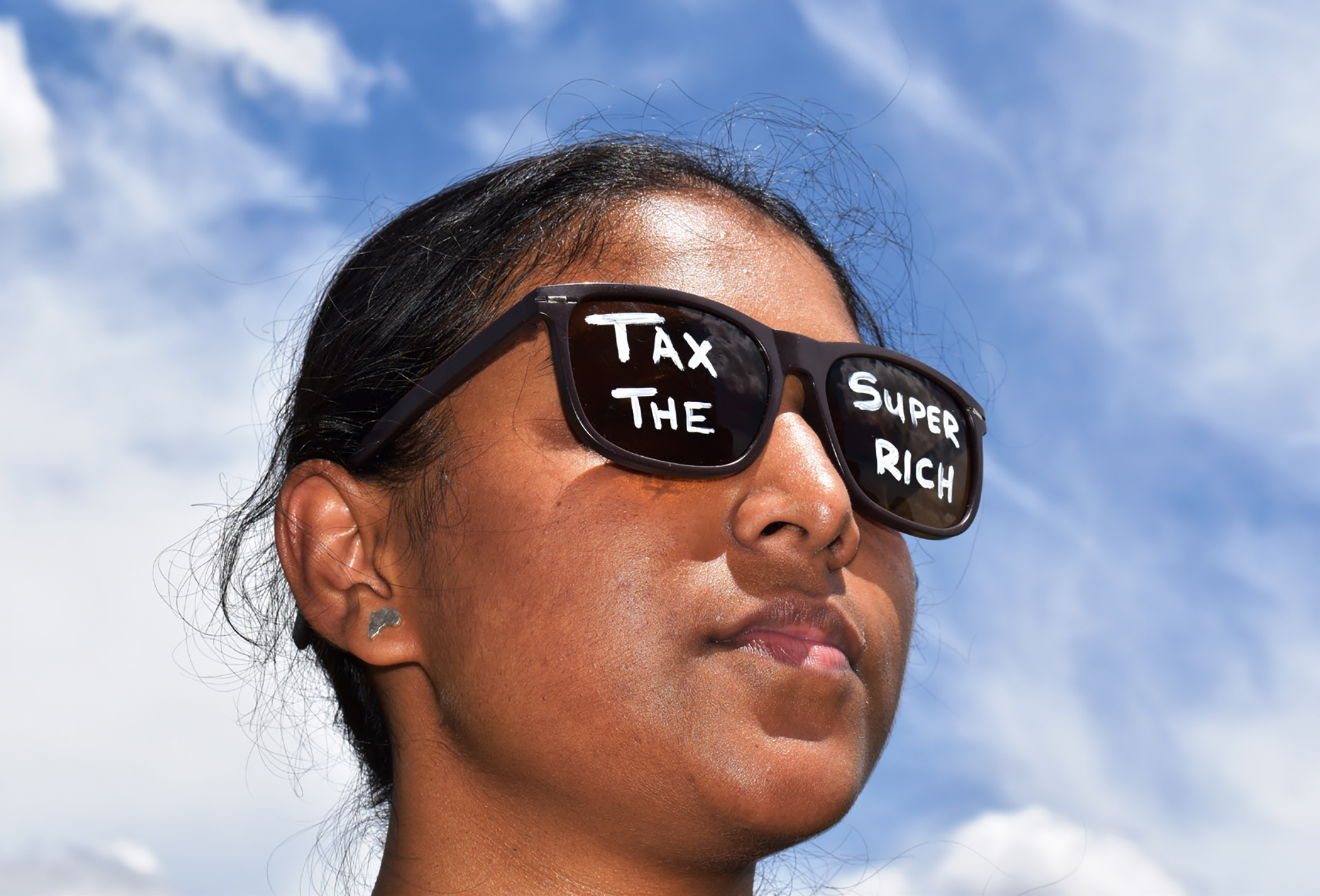
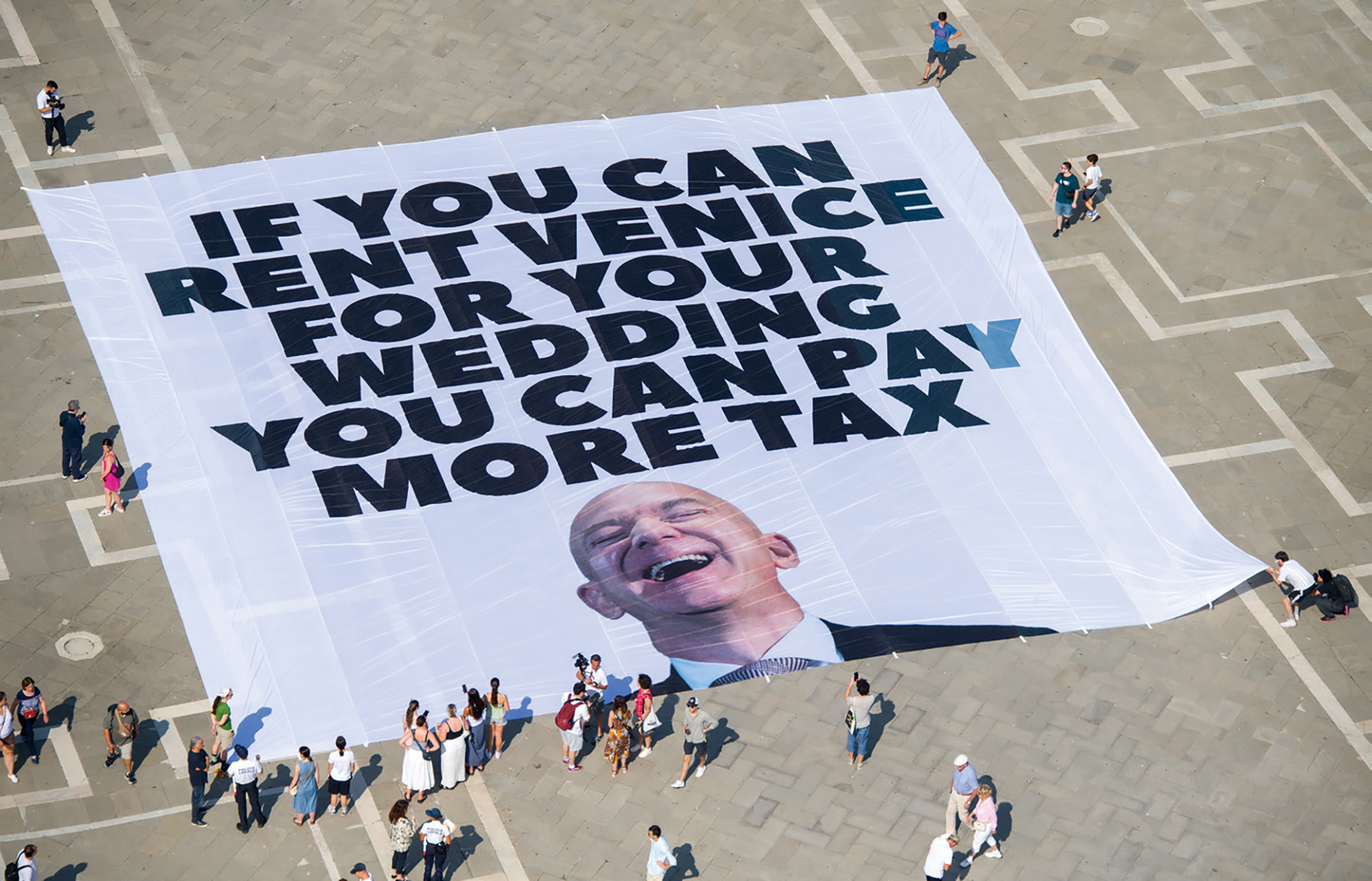
Now, once we understand that the main fiscal purpose of taxation is not to fund public services but to reduce excess demand, we can have a clear view of who should be taxed: the rich.
The problem with the rich is that, because they have so much money, they demand too much of our productive capacities. Their money translates into massive purchasing power (and also enables them to increase their investments and ownership of production). So we are then required to use our labour and resources to produce things like mansions, private jets, sports cars, estates, luxury goods and so on. This facilitates elite consumption and accumulation but it does not benefit society – it is wasteful, ecologically destructive, and it should be curtailed so that we can undertake production that does benefit society.
Taxation can be used to help achieve this in two ways: a) tax income and wealth over a certain threshold, and b) tax damaging and unnecessary goods.
Ultimately, we do not need to tax wage labour at all.
‘All income below a certain minimum threshold should be taxed at zero per cent’
If a key purpose of taxing income and wealth is to reduce excess demand and consumption, then it is reasonable to implement a very simple and straightforward tax rule. All income below a certain minimum threshold (the level needed to acquire goods and services necessary to live a good life) should be taxed at zero per cent, and all income above a certain maximum threshold (a level beyond which additional consumption is clearly unnecessary and destructive) should be taxed at 100 per cent. This is consistent with calls for a maximum income policy.2
The vast majority of workers do not consume too much – in fact, in many cases they consume too little and struggle to make ends meet. If so, they do not need to be taxed.
A maximum income may sound radical, but it is perfectly reasonable once we understand that money is not just abstract credits that can be accumulated endlessly. It represents demand for – and enables increased control over – real labour and resources. Clearly it makes little sense to allow elites to consume as much of our labour and our planet – and our future – as they want.
A new narrative
The response from some on the right might be that under such a tax system the working classes would be contributing nothing whereas the rich would be contributing everything. But remember, taxation does not fund public services. The rich are not ‘contributing’ at all. Rather, we are preventing them from using too much of our productive capacity so that we can use it ourselves, for other purposes. So who is contributing? The working classes, in the form of their labour.
Workers literally build our society; they produce all the value and wealth that we collectively enjoy. And this is particularly true for public services. The doctors, nurses, teachers, train drivers, cleaners, engineers, builders, etc – it is their labour that makes our society good. Keynes understood that all production is ultimately ‘funded’ not by money as such, but by real resources and labour. If that’s the case, then public services are 100 per cent funded by the workers. And the output benefits the entire society. It is a gift they give to everyone, including the young, the elderly and anyone else who cannot work.
‘Workers literally build our society; they produce all the value and wealth that we collectively enjoy. And this is particularly true for public services’
Now, the point of taxation is not only to control inflation. It also delivers several other crucial benefits. For one, it reduces the power imbalances that come with inequality. Excess income is excess power. Elite accumulation enables oligarchs to bankroll political campaigns, monopolize media outlets, and influence elections and policymaking in their own interests. This corrodes society and corrupts democracy. It is in fact impossible to have a functioning democracy under these conditions. Taxing the rich is crucial to preventing these perversions.
It is also important for ecology. Remember, taxation reduces purchasing power. Right now, millionaires alone are on track to burn 72 per cent of the remaining carbon budget – the target for greenhouse gas emissions reduction – to limit global warming to 1.5 degrees Celsius.3 Taxation can be used to reduce destructive and unnecessary forms of production and consumption, thus reducing energy use and enabling faster decarbonization.
Elite accumulation occurs because capital pays workers less than the value they produce, and appropriates the surplus as private wealth.4 This is not something the elite are entitled to – not something they ‘make’ or ‘earn’, contrary to dominant rightwing narratives. It is appropriated. This pattern enables capital to accumulate yet more control over investment and production, and of course it invests in ventures that are profitable to capital even if they are clearly harmful to people and planet. Taxing the rich prevents elite accumulation and ensures that our productive capacities can be invested instead in socially beneficial objectives.
Of course, taxation is not the only mechanism for achieving these objectives. Credit policy – rules that limit the quantity of finance that commercial banks can invest in problem sectors – is just as important, and should be deployed as part of the same package.5 Here is the problem, explained very briefly: Under capitalism, states grant the power of money creation to commercial banks. Banks then create money when they make loans. But much of their lending goes to industries that are destructive and damaging – such as fossil fuels. So, we need a way to deal with this.
Credit policy allows us to control the lending operations of commercial banks. We can use it to reduce their investments in damaging or unnecessary industries that we want to scale down, or ‘degrow’. Like taxation, this reduces capitalist demands on the productive capacity of the economy, controlling inflation. It functions as what economists call a ‘non-fiscal payfor’ that ‘funds’ public production; in other words, by reducing credit flows to certain industries, they produce less, and thus real resources are made available to be used for other purposes such as public projects.

Post-capitalism?
All of this amounts to a fundamentally different way of thinking about taxes – and indeed about money more broadly. But it raises a question: If this approach to public finance is so straightforward, why don’t governments do it? The short answer is because they are capitalist. The strategies I have described here represent an increase in democratic public control over productive capacity. And it enables us to achieve urgent social and ecological objectives. But it necessarily reduces capitalist control over production, which of course runs against the interests of capital.
This is why our politicians reproduce false narratives like ‘we have to tax before we can spend’ and ‘we must reduce the deficit’. Myths like these rein in our expectations for how much public production we can do, and indeed justify curtailing public production (austerity) in order to ensure that a larger share of our productive capacity remains in the hands of capital.
If the left accepts these narratives, we box ourselves in. We are forced to fight on a terrain defined by our opponents, and we lose. We need to break out of this straightjacket and declare a stronger narrative and grander ambitions.
Here is the bottom line: We are the producers. All production requires our labour and resources. Right now our productive capacities are controlled overwhelmingly by capital – commercial banks, large firms, and the one per cent who own most investible assets – and organized around what is profitable to them. As a result, we are prevented from producing what we know is necessary for human wellbeing and ecology.
But we can take this power back. We can leverage the power of public finance to accelerate social and ecological progress, while reducing elite control over our labour and resources at the same time. With more democratic power over our productive capacities, we can build a just and ecological civilization – and we can do it now.
- Jo Michell, ‘What should the Left think about tax?’, Tribune, 29 September 2020, a.nin.tl/think
- Sam Pizzigati, The Case for a Maximum Wage, Polity, Cambridge, 2018 and Ingrid Robeyns, Limitarianism: The Case Against Extreme Wealth, Penguin, London, 2025.
- Stefan Gössling and Andreas Humpe, ‘Millionaire spending incompatible with 1.5°C ambitions’ in Cleaner Production Letters, Vol 4, June 2023, a.nin.tl/spending
- The output of a capitalist firm (measured in the prices of the goods it produces) is always greater than the cost of production (the labour and material inputs). Therefore workers are rewarded with a consumer power (wages) that is less than the value they produce. In other words, workers consume less than they produce, and the difference is pocketed by the capitalist class.
- Jason Hickel, ‘Credit guidance: how we achieve degrowth’, jasonhickel.org, 20 August 2024, a.nin.tl/credit
