
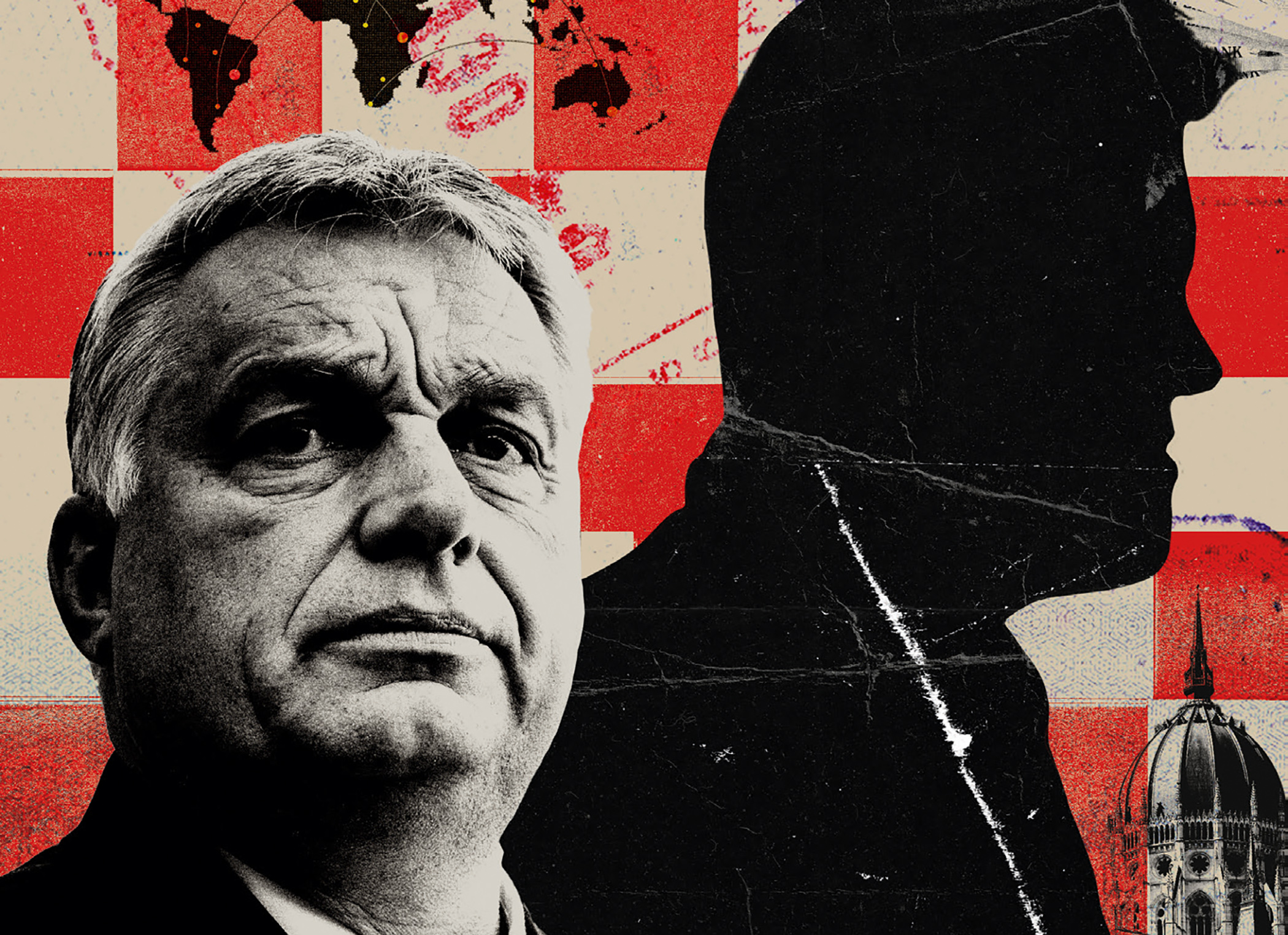
When Hungary’s Prime Minister Viktor Orbán lost a closely fought election in 2002, he was searching for answers. Árpád Habony, then a little-known political adviser, is apocryphally said to have delivered the line that earned him Orbán’s lasting trust: ‘We didn’t want to win enough.’1 His supposed advice for the defeated leader was equally blunt: ‘Stop acting like a prime minister, you’re not one anymore. Stop acting like a party leader, you’re not that either. Just act like a man from Felcsút,’ the hometown of the Hungarian leader.2
Habony’s role in the aftermath of that election helped him become one of the most influential figures in Hungarian politics, and he is widely credited with helping, in part, engineer re-election for Orbán’s Fidesz party in 2010.
Over those 15 years, Hungary’s far-right leader has turned the country into what he describes as an ‘illiberal democracy’, eroding democratic institutions, capturing the press and changing electoral laws to cement his power. Shifting decidedly from the centre right to the far right, Fidesz has relentlessly targeted immigrants, the LGBTQI+ community and liberal elites, in media campaigns often directly attributable to Habony.3
Yet despite his seeming influence, Árpád Habony remains a mystery. Little is known about his early life beyond a few eclectic details: he studied ornamental sculpture, worked as a car mechanic and became a skilled Kendo master.3
The Hungarian government has consistently denied any formal affiliation. He holds no official position and receives no public salary.4 One theory for his lack of explicit appointment is his criminal record: in 2006, he received a two-year suspended sentence for assaulting a couple in their 50s who tried to cross the street in front of his car.5
Despite this, Habony still wields inordinate influence over Hungarian society, through stakes in a web of media ventures, casinos and a golden visa scheme for wealthy foreigners.6,7 He even reportedly maintains stakes in the national defence industry.8
But his influence extends far beyond Hungary’s borders. He has become a central conduit for Orbán’s foreign policy ambitions. In recent years, Habony has advised at least half a dozen parties and candidates across Europe and beyond – exporting the political strategy that helped secure Fidesz’s dominance at home. In doing so, he has positioned himself not just as a domestic power broker, but as a key architect of exporting Orbánism.
Shadow strategists
Habony is part of a little-discussed but increasingly influential phenomenon in global politics: the rise of the international campaign consultant. These political operatives, often veterans of high-level elections, bring with them everything from fundraising expertise to data analytics and media strategy skills.
This sort of expertise can be especially valuable for far-right movements, whose political vehicles are often relatively new and under-resourced with inexperienced staff. The insights of these consultants can easily cost $10,000 to $15,000 per month with contracts in the high six figures not being unheard of, and they can rapidly professionalize political campaigns.
In a climate where far-right parties are often willing to push ethical and moral boundaries themselves, the impact of these consultants can be even more pronounced. Tactics such as bot farms, co-ordinated disinformation campaigns and the deliberate spread of fake news can profoundly shape public perception and far-right parties have shown little hesitation in deploying them. Figures like Habony don’t just bring modern campaign tools; they provide the infrastructure and strategic know-how to run sophisticated influence operations, often skirting traditional campaign finance rules and regulatory oversight.9
Of course, this phenomenon is nothing new. US political consultants have been working abroad for decades. Their services are not exclusive to the right, but they are an extremely useful if often overlooked tool in the global far right’s expansionary project, as a vehicle to share tactics and strategies amongst each other.
Two of the most consequential and enduring far-right leaders of the modern era, Viktor Orbán and Benjamin Netanyahu, are difficult to understand without recognizing their early and enthusiastic embrace of US-style campaigning. In Israel, virtually every major political party hires US consultants; it has become almost a prerequisite for being taken seriously. Orbán, for his part, benefited from the advice of American consultants funded by the EU’s centre-right European People’s Party.
Unlike most consultants, who work independently or on contract, he occupies a blurred space between state emissary and mercenary for hire
Habony fits squarely within the transnational class of political operatives, but with one key distinction. Unlike most consultants, who work independently on contract or retainer, he occupies a blurred space between state emissary and mercenary for hire, and travels with a diplomatic passport.10 His work abroad is not merely for commercial gain: it is strategic, part of Orbán’s broader effort to cultivate and consolidate a network of international allies.
Habony is in many ways the product of the US Republican strategist Arthur Finkelstein, an early innovator of negative campaigning – focusing on discrediting opponents rather than promoting his own candidates in a positive light. His key successes include propelling Ronald Reagan into national prominence in the 1976 Republican primary and Netanyahu in 1996, who later introduced Finkelstein to Orbán ahead of Hungary’s 2010 elections.
Finkelstein advised Fidesz to go relentlessly negative, attacking the government while keeping Orbán himself largely out of the spotlight. The result was a landslide: Fidesz won 263 of 386 seats with just over 52 per cent of the vote – enough to unilaterally rewrite the constitution.
With Orbán firmly in control of the state, Hungary would be able to channel public resources to fund a global network of right-wing causes, from media outlets, to think tanks, academic fellowships and political consultants like Habony. These investments have helped rebrand Hungary as a conservative utopia in the eyes of the international right, despite the country recently being declared the poorest in the European Union.11
Finkelstein, who remained involved in Hungarian politics even after the election, continued to collaborate with Habony. The year following Fidesz’s 2014 re-election, the two formalized their partnership by founding Danube Consulting, a joint venture registered in London aimed at exporting their political strategies abroad. The creation of the firm marked a turning point in Habony’s international ambitions.
Habony unleashed
Demand for Danube Consulting’s services was immediate. In 2016 Habony advised the right-wing Croatian Democratic Union’s election campaign, as well as former French President Nicolas Sarkozy’s failed political comeback.12 Following Finkelstein’s death in 2017, he took full control of the firm.
At this stage, Habony’s work still resembled that of a conventional campaign consultant, securing contracts from several European People’s Party-aligned politicians. But as Orbán’s increasingly authoritarian turn drew mounting criticism internationally, the regime began to sense that preserving its grip on power at home required cultivating allies abroad. In response, the government’s strategy shifted with Habony as a central player.
Around this time, Orbán-aligned members of the regime began building media operations outside of Hungary. Habony travelled to Washington to meet with Trump’s former adviser Steve Bannon, where they discussed launching a Breitbart-style outlet.13 And then, in an attempt to support Orbán’s allies in North Macedonia and Slovenia, Habony bought up media organizations in those countries. In particular, newspapers aligned with Janez Janša – Slovenia’s right-wing, Orbán-aligned prime minister, were rescued from near bankruptcy through his intervention.13
Habony’s Slovenian outlet Nova24 promoted reactionary conspiracy theories ahead of the 2018 Slovenian elections, claiming that the United Nations’s refugee agency UNHCR distributed credit cards to migrants, allowing them to receive thousands of euros per month, and paid to promote Janša’s party on social media.14
In early 2019, the London-based V4NA news agency was launched, with Habony holding a minority stake. The agency promoted the Hungarian government’s messaging, churning out anti-immigration stories in multiple languages including English. Orbán denied any official connection even after Kristóf Szalay-Bobrovniczky, Hungary’s then ambassador to Britain was revealed as its owner.15
By 2023 Habony was back on the campaign trail, advising Poland’s ruling Law and Justice (PiS) party, one of Orbán’s closest allies in the region. While that was ultimately unsuccessful (PiS lost to Donald Tusk's centrist Civil Platform party) he was successfully able to keep the Orbán-aligned government in power in the 2023 elections in Slovakia.16 The lead-up to both those elections also saw the Hungarian government spend money on ads raising the alarm on ‘the dangers of illegal immigration’ to Polish and Slovak voters.17
More recently, Habony was said to have advised the Georgian Dream Party, helping them develop the conspiratorial conservative tone that was a keystone of their electoral campaign.18 These are only the publicly known cases in Europe. For every documented campaign, it is likely that others remain unknown. Consultants like Habony often operate in the shadows, and given the lax financial disclosure requirements for campaigns in many countries, their activities are difficult to trace. The use of shell companies, informal networks and off-the-books arrangements makes comprehensive documentation nearly impossible.
What is known, however, is that Hungary facilitated large bank loans to Marine Le Pen’s National Rally in France and the far-right Vox party in Spain.19,20 While the precise details remain opaque, it would not be surprising if Habony – or another Hungarian consultant – was involved behind the scenes.
Budapest to Mar-a-Lago
Habony’s influence has also been traced further afield. David Cornstein, the former US ambassador to Hungary and a close ally of the US president, reportedly lobbied the Trump 2024 campaign to bring Habony on as an adviser.21
An enthusiastic admirer of Orbán, Trump publicly highlighted the Hungarian leader’s endorsement during his sole debate with Kamala Harris. In office, Trump has echoed key elements of Orbán’s authoritarian playbook – weaponizing democratic institutions and intensifying culture war narratives. He even championed free access to IVF on the campaign trail, a signature policy of Orbán’s natalist agenda aimed at boosting fertility rates.
But ties between the two regimes may go deeper than admiration. According to Radio Free Europe, during a trip that also included a meeting with Argentine President Javier Milei, Habony is said to have flown on a private jet to Mar-a-Lago, where he met with senior Trump officials.22 He was then reportedly given a role within the Trump campaign.23
However, neither Habony’s name nor that of his consulting firm appears in Federal Election Commission records – a legal requirement for anyone receiving compensation or making contributions in connection with a US political campaign.
Neither the Trump White House nor Habony’s V4NA news agency responded to requests for comment regarding his alleged role in the campaign. Yet in a clear acknowledgment by Fidesz of how potent such operations can be, the Orbán government has established a so‑called ‘sovereignty protection office’ to police even the hint of foreign interference in Hungary’s own elections. That office is headed by none other than Tamás Lánczi, a former managing director of Habony’s Danube Consulting – underscoring the revolving door relationship between this class of political operatives and the Hungarian state.24
Árpád Habony may nominally belong to the increasingly influential class of international campaign consultants, but he has become part of Hungary’s broader constellation of state‑subsidized operatives, exporting political strategies on behalf of an authoritarian regime. In doing so, he blurs the line between consultancy and covert influence, opening the door for Orbán to shape electoral outcomes abroad under the guise of private political advising.
- Robert Puzser, ‘A populizmus gyakorlata’, Mandiner, 18 October 2022, a.nin.tl/wisdom
- ‘Ma 50 éves Habony Árpád…’, Nyugati Fény, 1 Janaury 2018, a.nin.tl/iman
- J Lester Feder and Rebeka Kulcsar, ‘Meet the mysterious man…’, BuzzFeed, 4 April 2018, a.nin.tl/mystery
- ‘Kiderült, kitől kapott…,’ Index, 1 july 2015, a.nin.tl/NoRecord
- ‘Narancs: Habony egy…’, hvg, 27 February 2013, a.nin.tl/assault
- Vitéz F Ibolya, ‘21,4 milliárd forintot…’, 24.hu, 30 June 2025, a.nin.tl/casino
- Blanka Zöldi, ‘Viktor Orbán’s advisor…’, Direkt36, 30 June 2025, a.nin.tl/visa
- Gregory Toth, ‘Habony Árpád megjelent a hadiiparban’, Telex, 22 May 2025, a.nin.tl/military
- Jill Colvin and Llazar Semini, ‘Trump’s architects are now…’, The Seattle Times, a.nin.tl/rules
- Katalin Erdélyi, ‘Orban’s spin doctor…’, VSquare, 29 May 2019, a.nin.tl/passport
- ‘Once prosperous, Hungary…’, The Economic Times, 20 June 2025, a.nin.tl/poor
- Joseph Spirk, ‘Habony fél évvel…’, 24.hu, 3 September 2018, a.nin.tl/Danube
- Patrick Kingsley, ‘Safe in Hungary…’, The New York Times, 4 June 2018, a.nin.tl/SteveBannon
- Bence Horvath, ‘Habony szlovén…’, 444.hu, 7 November 2018, a.nin.tl/Slovenia
- Shaun Walker, ‘London Media Agency…’, The Guardian, 5 May 2019, a.nin.tl/V4NA
- Szabolcs Panyi, ‘Goulash: Orbán’s campaign…’, VSquare, 1 November 2024, a.nin.tl/Slovakia
- Szabolcs Panyi, ‘How Orbán Flooded…’, Direkt36, 29 February 2024, a.nin.tl/ads
- Nate Ostiller, ‘Did Hungary help…’, OC Media, 8 February 2025, a.nin.tl/Georgia
- ‘France’s Le Pen…’, Reuters, 30 June 2025, a.nin.tl/LePen
- Andrea Horváth Kávai and Patakfalvi Dóra, ‘Spanish prosecutor investigates…’, Telex, 11 March 2025, a.nin.tl/Vox
- Sophia Cai, ‘The GOP-Hungary…’, Axios, 8 May 2023, a.nin.tl/Trump
- Flora of Garamvölgy, Keller-Alant Akos and Gabriella Horn, ‘Titokban Habony is elrepült…’, Radio Free Europe, 14 September 2024, a.nin.tl/JavierMilei
- Kerényi György, ‘Matolcsyék leléphetnek, Habony…’, Radio Free Europe, 31 March, 2025, a.nin.tl/campaign2024
- Mizsur András, ‘He used to be…’, telex, 2 January 2024, a.nin.tl/Tams
