Historic memory: Solidarity Park
Gentle waves roll onto the sandy shores of Malgrat de Mar, a small town north of Barcelona, as a group gathers near the seafront. ‘No pasarán also means, we will not forget’, English artist Rob MacDonald tells the crowd. But for many years, an atrocity that took place along this scenic stretch of coastline had been forgotten, submerged by a deliberate policy to wash away the crimes of fascist dictator Francisco Franco.
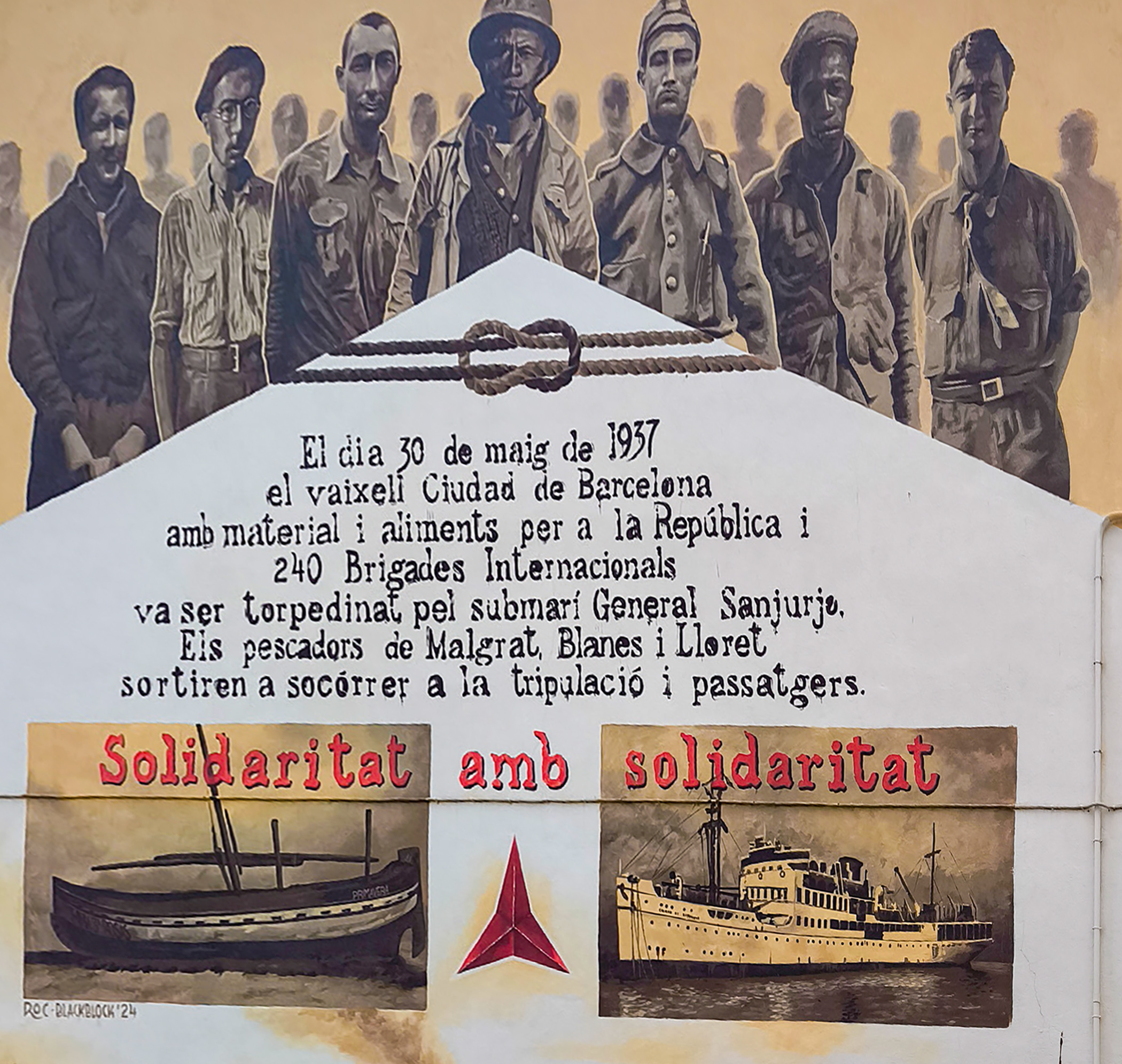
On 30 May 1937, the Ciudad de Barcelona, a ship carrying 300 International Brigade members who had volunteered to fight fascism in Spain, was torpedoed by Italian forces backing Franco. Local fishers rushed out to sea to save people from a watery grave, but at least 60 people died.
Determined to revive this hidden history, MacDonald, who lives in Catalonia, and a group of local artists and historians created Solidarity Park: a living memorial, as well as an educational and artistic project and an annual festival. At the heart of it all is a sculpture MacDonald spent two years carving, depicting the fallen brigadiers.
The group also works in local schools to tell the story of the Ciudad de Barcelona and the history of Spain’s civil war between Franco’s fascist forces and the progressive but short-lived Spanish Republic. ‘We knew that it had to be a project that involved young people, because they were the future of preserving the historic memory,’ says MacDonald. As well as learning the history, the students contribute to the sculpture itself by designing artwork to fill the ‘portholes’ on the monument. Each year four new designs are carved into the stone. Some show fists protruding defiantly out of the sea.
Remembering the Ciudad de Barcelona is in itself an act of resistance. MacDonald notes that Solidarity Park would not be possible in other regions of Spain where the remembrance of Francoist crimes is still actively suppressed. Spain’s far-right party Vox and the conservative Popular Party (PP) have blocked and even tried to annul laws preserving historical memory. They push a revisionist history that whitewashes Franco’s brutal dictatorship.
By unearthing these difficult memories, young people get to understand what fascism is and to identify it today. In this sense the project is not detached from the present, where far-right violence and power is a resurging threat in Spain, seen in racist mob violence that broke out in Murcia in July and the political gains of Vox in recent years.
MacDonald also believes there are lessons to be learnt from history. During the civil war between 1936 and 1939, tens of thousands of men and women from more than 50 countries, including Britain, the US, France, New Zealand, Australia and the Soviet Union, volunteered to fight Franco. Some 11,000 Brigaders died on Spanish soil.
‘Remembering the International Brigades is not just a nice story or a nice bit of history,’ MacDonald says. ‘It’s actually something that is super relevant, and we can draw a lot from the sacrifice they made.’ The Spanish Republic brought women’s suffrage, land redistribution and public education. When the Spanish army led by Franco staged a coup in 1936, people around the world recognized that ‘it was their fight too’, the sculptor says.
The International Brigades believed that people did have the power to change society for the better, he explains, and ‘that’s what undermines the far-right ideologies of today… you need to have solutions.’
Back at the beachfront, the ceremony closes with the Internationale, the socialist anthem reportedly sung by the men trapped below deck as the Ciudad de Barcelona sank. Eighty-eight years later, their memory has finally come to the surface of public consciousness: and through the work of Solidarity Park, is here to stay.
‘Discourse is power’: Chkoun
Anti-Black racism in Tunisia has deep roots. But since President Kais Saied’s incendiary 2023 speech accusing sub-Saharan African migrants of plotting to ‘change the demographic make-up’ of the country, that racism has escalated into vigilante violence and a brutal anti-immigrant crackdown.
His rhetoric unmistakably invoked the ‘Great Replacement’, a racist conspiracy theory once confined to fringe far-right movements in Europe but one that has since been adopted by global leaders including Viktor Orbán and Donald Trump (see Facts, page 23). One protester in Tunis described it as the ‘first fascist speech to this degree in the history of Tunisia’.1
Unable to improve the lives of citizens, Tunisia’s autocratic leader has sought an easy scapegoat on which to pin Tunisia’s economic woes: the already marginalized community of Black migrants and refugees heading to Europe. The fall-out from the speech was immediate. Armed with Saied’s words, racist vigilantes went on the rampage, some wielding batons and knives to attack Black people on the streets. Black migrants were arrested and stripped of basic services by the state. NGOs and organizations supporting migrants were criminalized and their leaders locked up. Prominent Tunisian anti-racism activists like Saadia Mosbah remain imprisoned two years on.
In Berlin, Salma*, a member of the Tunisian diaspora community, watched in horror. ‘[We could] not just sit with the anger at what’s happening,’ she says. She co-founded Chkoun, a collective aimed at countering anti-Black racism in Tunisia and the wider region.
Through teach-ins, events and an online resource library, they aim to debunk disinformation fuelling racist violence, raise awareness about the roots of anti-Black racism in North African countries and change the story.
‘We also had to think about what we can do from the diaspora,’ explains Leyla*, another member of the collective. Challenging Saied’s policies inside Tunisia was not an option, so they decided to focus on narrative. ‘We deeply believe that discourse is power,’ Leyla says.
The violent response sparked by Saied’s speech shows how powerful words can be. This extreme reaction, Leyla explains, didn’t come out of nowhere. It was the result of decades of unchallenged racist attitudes, and the region’s unresolved history of dehumanizing Black Africans, including through Trans-Saharan slavery.2 ‘I think it takes a lot of years of conditioning to make it okay…that somebody tells you, “oh, this person is here illegally, so they deserve to die,” for you to act on it,’ she adds.
Instead of remaining in private conversations, Chkoun wants to bring these discussions into the open. They host events and conversations with the North African diaspora in Germany. ‘Usually the first reactions we have are very curious,’ says Salma. ‘Racialization and how race is constructed in our region is really something not so talked about, so it’s filling a huge gap.’
But they also want to raise awareness of the EU’s role in fuelling racism and authoritarianism in North Africa. As one of the exit points for people trying to reach Europe, Tunisia has become a key partner in Europe’s border externalization strategy. Italy’s far-right leader Giorgia Meloni has visited Saied four times since 2022, helping broker a €230 million ($269 million) EU-deal to stop refugees before they reach Europe.
‘One cannot ignore how linked it is to the far right in Europe,’ says Salma, referring to Saied’s immigration crackdown. ‘It came really after lots of visits by the Italian Prime Minister, who’s openly a fascist.’
Guided by principles of transnational solidarity, Chkoun is also forging connections with migrant justice groups in Europe and NGOs in North Africa. They’ve organized a letter-writing campaign to imprisoned NGO workers in Tunisia, using their position in Europe to amplify calls for solidarity and action.3
With far-right ideas and tactics crossing borders, Chkoun’s solidarity work at home and abroad provides important lessons in the fight against the spread of reactionary politics.
Building community: Hope not Hate
‘In 15 years, our country will be gone’, a man told me recently. It wasn’t difficult to surmise what he meant, especially after he confessed (somewhat sheepishly) to being a regular consumer of GB News, Britain’s rightwing broadcaster. Migration, he believes, is destroying Britain.
I was taken aback. In my bubble, Britishness is multiculturalism. Realizing we sat on opposite ends of the spectrum, our conversation fizzled out rapidly. But such exchanges, as difficult as they might be, are increasingly necessary.
Half of Britain believes multiculturalism is not working.4 That is why Hope not Hate, the UK’s largest anti-fascist organization, began its ‘Difficult Conversations’ programme: to help people talk calmly and productively about divisive issues. They train frontline workers – social housing providers, council staff, trade union officers among others – who interact with the public daily.
‘Shifting the dial in attitudes will take more than one conversation, and so these practitioners are key,’ says Hope not Hate’s senior policy officer Misbah Malik. The programme, she explains, equips frontline workers with the tools to hold a conversation that does not shut the other person down ‘in a way that could further entrench them in their views, but engages with empathy and curiosity’.
Difficult Conversations doesn’t promise to change minds overnight. Instead it focuses on encouraging critical thinking and media literacy. It was born in the wake of Brexit, when frontline workers began noticing an increasing number of people expressing hostile views around migration and other topics considered part of the culture war, Malik says. Now organizations proactively seek out this training to better support staff in managing difficult conversations constructively.
While this approach may seem like a drop in the ocean, it’s only one strand of the organization’s work to tackle far-right attitudes and influence in Britain. Alongside trainings, Hope not Hate works on the ground to build what it calls community resilience, creating strong, connected communities that are less susceptible to far-right influence.
‘We’ve been running a campaign in Bradford for well over a decade,’ says Joe Mulhall, the organization’s lead researcher. ‘During the pandemic, they were doing food banks. They [also] do events at the local rugby club and the football club. That work is fundamentally important to almost inoculate communities against far-right politics, so that they have a sense of pride and community. In an age where we’re all, I think, feeling uprooted – there’s no youth clubs, there’s no libraries, trade unions have fewer members... That sense of dislocation is something that the far right can really prey on.’
Instead of parachuting left-wing activists into a town a few weeks before an election, Hope not Hate organizers are part of neighbourhoods, building long-term connections and, most importantly, trust. This investment is increasingly urgent with the rise of Reform UK, the far-right party led by Nigel Farage. Planting seeds of doubt through constructive conversations could be an important first step.
- ‘Tunisians rally against…’ The Guardian video, 26 February 2023, a.nin.tl/antifascist
- Bob Koigi, ‘The forgotten Arab…’, Development and Cooperation, 27 October 2024, a.nin.tl/trade
- Support Tunisians’ call to release human rights defenders by visiting a.nin.tl/CallOut
- Report, ‘Fear and Hope 2024…’, Hope not Hate, 24 September 2024, a.nin.tl/multiculturalism
