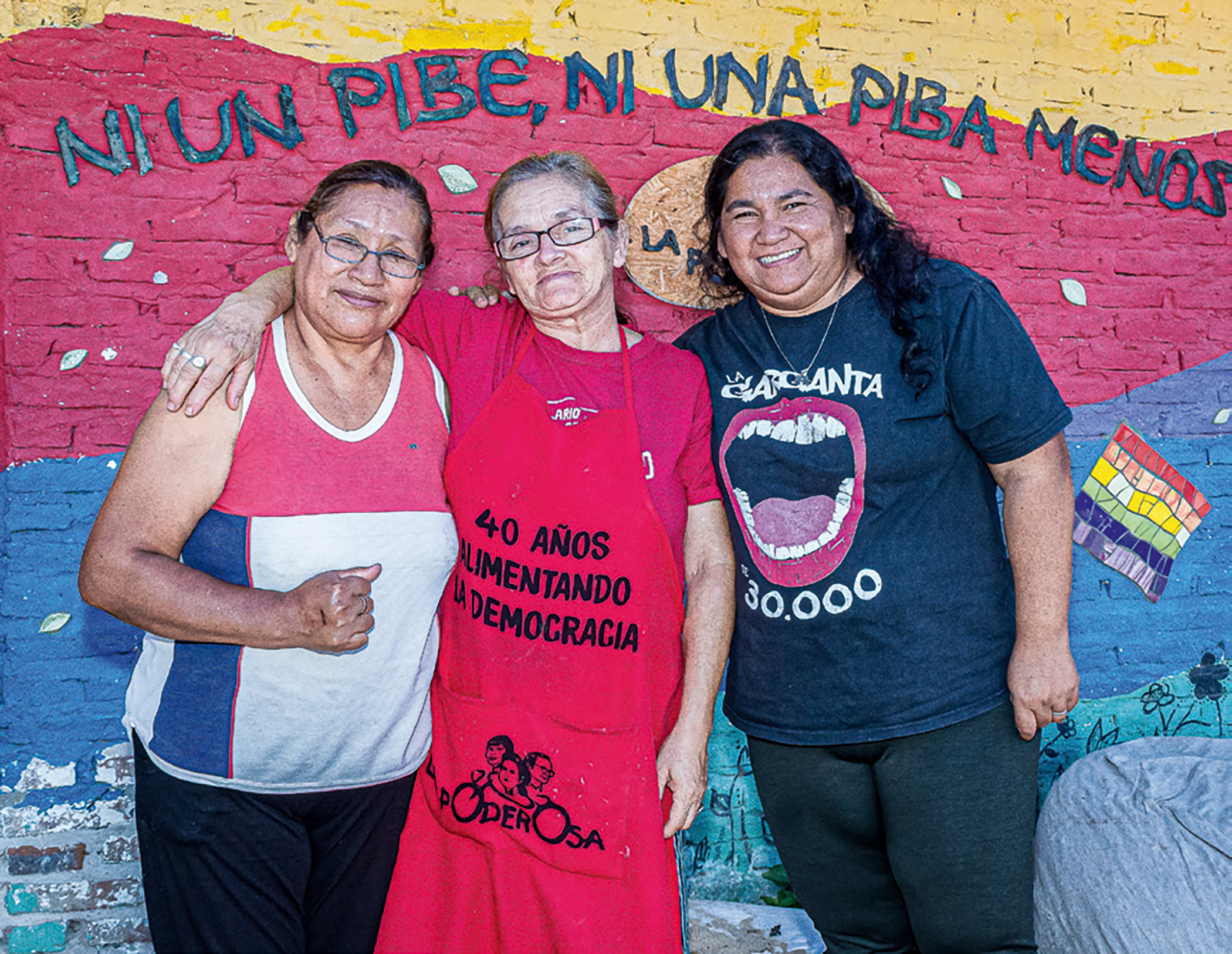
Eudelia Galeano is busy stirring a mix of rice, herbs and some chicken in one of three large metal pots that simmer on top of a wood-burning stove in a crowded community kitchen in barrio Fátima, a working-class neighbourhood in Argentina’s capital, Buenos Aires.
Outside, winter is setting in among hundreds of modest redbrick homes, only accessible via a maze of narrow passages buzzing with bikes and scooters. Thick cables hang over the winding streets, blocking the sun from some of the more than 2,600 homes that make up this informal neighbourhood, which was built in the 1970s on top of a former rubbish tip. More than half a century later, barrio Fátima is still home to many unemployed families – and, increasingly, workers who cannot afford to rent anywhere else. Many homes here lack access to basic services such as running water, gas and even sewage.
Back in the community kitchen, Galeano, 63, says that she has perfected her skills as a cook over the years. More recently, she has also had to become an expert at ‘making magic’: the challenge of feeding more and more people with dwindling resources.
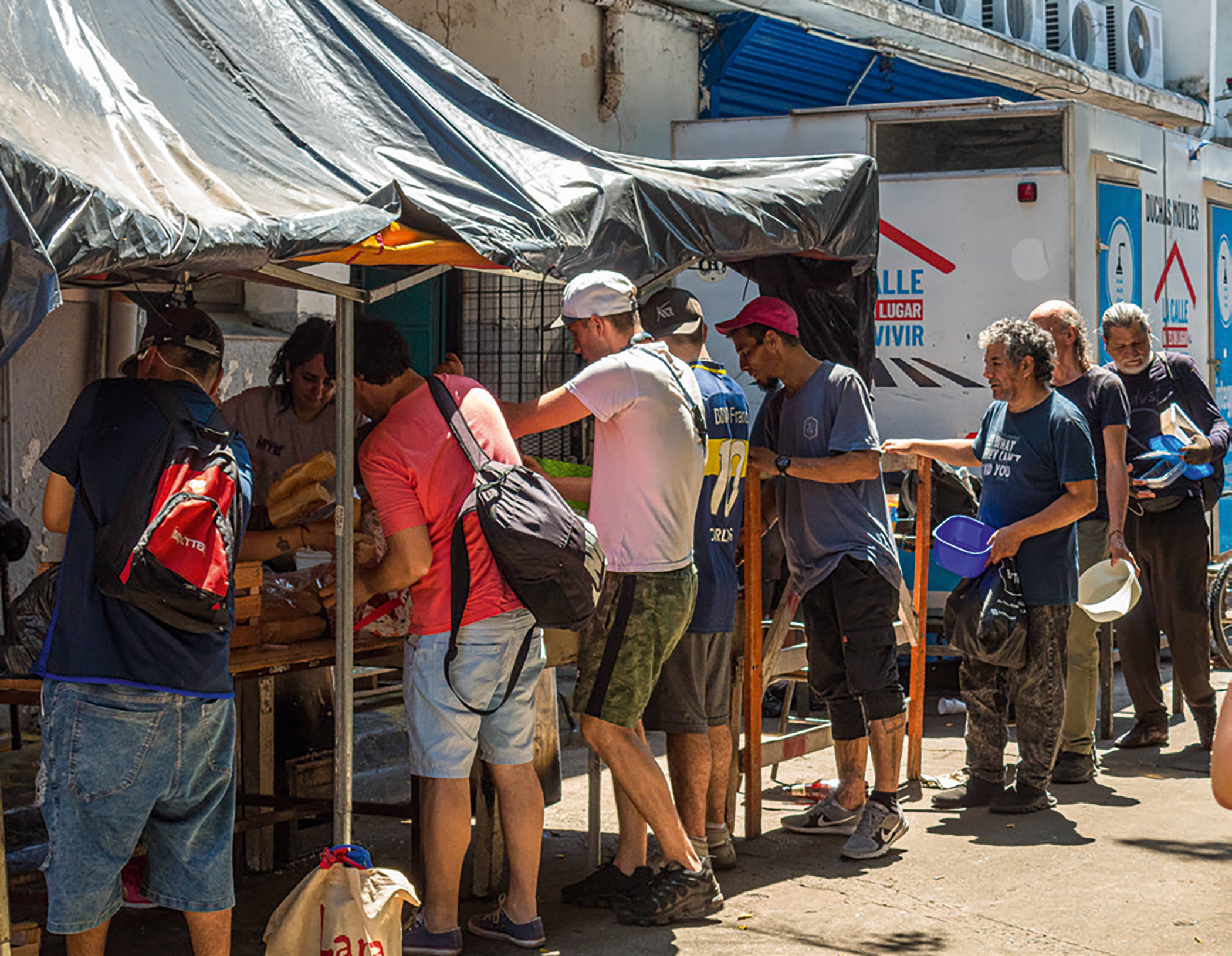
The kitchen – run by La Poderosa, a country-wide grassroots movement led by thousands of women – opens three times a week, on Mondays, Wednesdays and Saturdays. Galeano says they’re now seeing an increasing number of working men and women turning up at the kitchen, with many queuing up as early as 9am to secure a hot meal at lunch.
‘The story of Argentina is being written as we speak, and much of it is being written by social movements, on the streets’
‘What would happen if these soup kitchens did not exist?’ Galeano asks out loud. The expressions of the women around her provide a tragic answer.
Grassroots organizations say that even though Argentina’s economy has long been in decline, the situation has rapidly worsened since far-right President Javier Milei took office in late 2023.
A political outsider and a liberal economist by trade, Milei erupted onto the scene not long before with a blend of far-right politics and extreme neoliberal economic policies, railing against women and LGBTQI+ people, social justice and progressives. Wielding a chainsaw on the campaign trail, Milei vowed to dismantle what he termed ‘the political caste’ – those he accused of squandering public funds – and cut down inflation, which was one of Argentines’ top concerns, for good.
Declaring a ‘war on the state’, Milei moved quickly to cut subsidies for public transport and public services such as electricity and gas as well as budgets for health, and education, measures that have plunged the most vulnerable into deeper hardship. At the same time, tax breaks for the wealthiest Argentines have put more money in the pockets of the rich.
While the measures helped to achieve a dramatic drop in the monthly inflation rate from 25.5 per cent in 2023 to 1.5 per cent, the lowest in three years, Milei’s aggressive neoliberal economic programme has come at a high cost.,
With the dismantling of key social programmes – including food aid to more than 40,000 soup kitchens – poverty and inequality have risen, as well as unemployment.2,3 Argentina is now among the most expensive countries in the Americas despite boasting the lowest salaries.4 All this, however, has not dented Milei’s popularity much. Especially not among the wealthy – who benefit from his corporate-friendly programme. Nor young men, enamored by the president’s macho persona and attempts to roll back progress on gender equality and minority rights, moves that have excited far-right leaders the world over.
More than food
Milei’s austerity drive is hitting urban barrios like Fátima and La Cava – a low-income neighbourhood in the north of Buenos Aires – the hardest. But resistance here is brewing. Grassroots organizations are stepping in to deliver the services once provided by the state. Among them is La Poderosa, which not only runs soup kitchens but also campaigns for access to basic rights and services.
In La Cava, a group of local women are taking a lunch break after rewiring a section of powerlines. The electricians are part of UTEP, a national trade union of informal workers organized into self-run co-operatives. The workers provide vital services, such as paving, sewer construction, rubbish collection and even a daycare for children, in many areas where outsiders won’t even enter.
‘What we [the co-operatives] do works because, first, we know what our own community needs, and secondly, because we can access places people from the outside cannot or do not want to access,’ says Daiana Aquino, a 32-year-old mother of one who trained as an electrician. ‘We are people from the community fixing our community.’
‘What we see now is this idea of “everybody for themselves”, which is the opposite of what we had been building for so long, that only together we can progress’
Fernanda Miño, a local leader from La Cava who ran an award-winning state-funded programme for urban improvements of informal neighbourhoods before it was shut down by Milei in January, says that what has changed since Milei came to power is the very idea of community.
‘What we see now is this idea of “everybody for themselves”, which is the opposite of what we had been building for so long – that only together we can progress,’ she explains.
Roots of resistance
Argentina has a long and rich history of political organizing. Grassroots social movements, as they are known today, were largely born out of the 2001 crisis – when the country’s economy collapsed and mass protests toppled the government.5
For people in marginalized communities, organizing became a survival strategy. ‘The ice-cream shop where my partner worked shut down and he was given a fridge as a way of payment,’ recalls Monica Troncoso, 47, a leader from La Poderosa in Fátima.
‘I had just given birth to my first child, and we decided to open a small shop, but we couldn’t do it alone. We got together with five other mums from the community and pooled our resources to manage the shop. We started buying and selling cardboard and sharing the child caring responsibilities, working together.
‘When we had a bit of money, we used to buy food in bulk and cook for all, it was cheaper that way. Without realizing it, we built a co-operative. In the barrio, we all know no-one can make it on their own.’
During the crisis, grassroots movements and unions were the force behind the occupation and reopening of factories that had been abandoned by bankrupt owners, turning them into co-operatives. These co-operatives were more than economic solutions – they became sites of empowerment. Movements began training workers, particularly women, in political organization and leadership.
‘We learned that we (grassroots social movements) are not here just to feed people, to run soup kitchens,’ Troncoso says. ‘We are here to claim our space. The only way to change things is by getting involved in political discussions, for women and other people from the barrios to be part of that.’
Since then representatives of Argentina’s social movements have taken a more active role in the public conversation, even making their way into Congress. In 2021, Natalia Zaracho, an activist with the Movement of Excluded Workers (MTE) from Fiorito, became the first woman from one of these grassroots movements to be voted into Parliament.
‘They want to silence us’
Over the past 20 years, Argentina’s social movements have grown, becoming among the most powerful in Latin America and a key site of organizing among the most vulnerable communities and sectors, as well as a crucial provider of social and food assistance. Often self-managed, grassroots and based on the ideals of emancipation, these groups are the antithesis of Milei’s market-driven, divisive and uncaring brand of politics.
This is why they’ve come under attack from Milei, says Julian Rebón, a researcher and expert in social movements. The administration has not only cut food aid to the groups, but launched smear campaigns and legal actions against its leaders, targeting women in particular, in a bid to curtail their power.
‘What we are seeing now is a far-right government seeking to refound the social order, challenging institutions and the rule of law,’ Rebón explains. ‘In this context, social organizations have become one of his favourite targets to attack and stigmatize, holding them responsible for the country’s decay and crisis.’
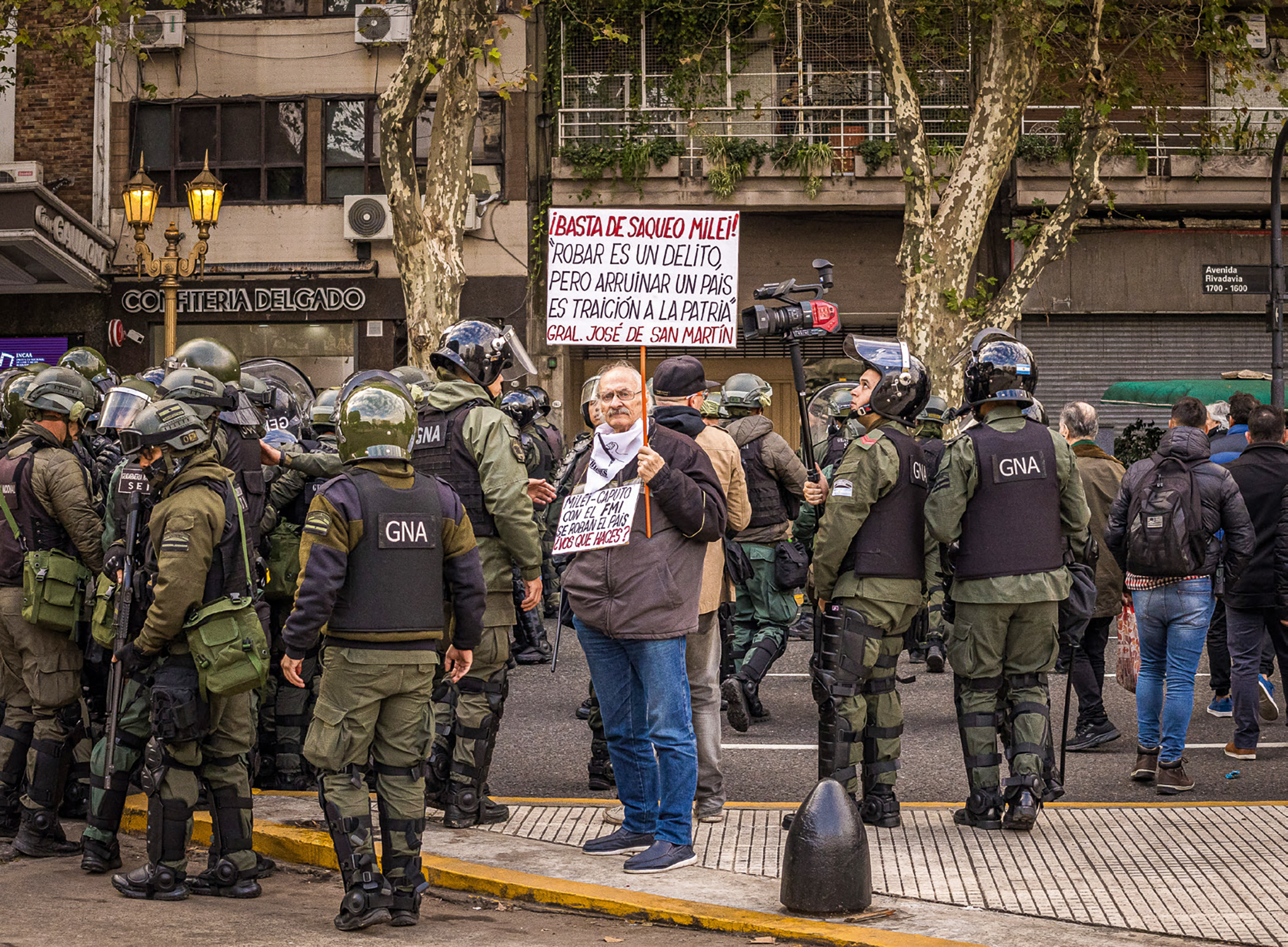
Milei has also taken aim at the trade union movement, as well as protesters opposing his austerity drive on the streets. Outside of Argentina’s Congress, a group of seniors have started holding weekly protests over their low pensions – $300 a month, below the poverty line.6 They’re often joined by doctors, scientists, students, feminists, trade unionists, people with disabilities and journalists, all sectors affected by cuts in public funding.
These gatherings have been met with brute force by police, while Milei has used a decree to severely limit the right to strike – although courts have temporarily halted the ban.
‘The government is targeting organizations because we are the space where people who suffer from their policies get together, we represent those who don’t have anything and they want to silence us,’ Troncoso explains.
A political force?
Analysts say the streets are now where the strongest opposition to Milei’s policies exist, as opposed to inside Congress, which is now home to a deeply fragmented political landscape.
‘People have seen that democracy is not just about casting a vote,’ says Edgardo Álvarez Puga, a Chilean sociologist specializing in popular education and social movements in Latin America. But the challenge, he explains, is turning the demands of individuals and movements into enduring political platforms.
Despite the barriers being placed in their way by Milei’s administration, could Argentina’s social movements present a political alternative to his reactionary politics? Rebón believes so. This is because of the strong networks they’ve forged over decades, and their ability to mobilize large numbers of people.
Grassroots social movements in Argentina hold a unique advantage that even progressive political parties lack, which is access and trust within the country’s poorest neighbourhoods. These communities are where most Argentines live, and are those who are being hit hardest by Milei’s unprecedented attacks on the poor. After many years of political organizing, these working class-led movements have developed the tools, and the willingness, to stand up to power. Their programmes of mutual aid and community-led co-operatives not only offer material support but also an alternative vision of Argentina that challenges Milei’s far-right project of individualism, authoritarianism and division: one based on care, co-operation and solidarity.
‘The outlook right now is very negative, but at the same time it’s open,’ Rebón says. ‘The story of Argentina is being written as we speak, and much of it is being written by social movements, on the streets.’
- ‘Inflacion’, Estudio del amo, last accessed webpage 11 July 2025, a.nin.tl/inflacion
- ‘Desigualdad, pobreza y consumo…’, ámbito, 9 April 2025, a.nin.tl/poverty
- María Cecilia Anello et al, ‘Rascar la olla…’ report, Rosa Luxemburg Foundation & Centro de Estudios Legales y Sociales, 25 October 2024, a.nin.tl/kitchens
- Federico Rivas Molina, ‘A coffee for $3.50…’, El País, 11 February 2025, a.nin.tl/pricey
- Argentina.gob.ar, ‘Estado de sitio…’, 16 December 2021, a.nin.tl/2001
- Por Mariana Leiva, ‘Jubilados: cuánto cobran en julio…’, chequeado, 10 July 2025, a.nin.tl/pensioners
