When German pastor Martin Niemöller sat down to write his famous poem ‘First They Came’ in 1946, he was already well acquainted with the horrors of inaction. The words were a quiet castigation of his fellow clergy members who had stayed silent during the rise and ruinous purges of the Nazi regime. Niemöller himself was an antisemite, but spent time in a concentration camp as punishment for his own opposition to the Nazi’s takeover of the church. He later admitted his own failure to fully condemn the regime and became an anti-war activist, travelling the world to warn people of the dangers of Nazism. But during the 1930s, as fascism was still solidifying its iron grip on the German state, Niemöller was mostly concerned with protecting his own interests, which mirrored those of the German Lutheran church.
As the United States faces down its own ongoing descent into authoritarianism, approximations of his now-iconic words have rung out at rallies and been painted on protest signs. People here are speaking out – but not always for everyone. The labour movement bears the distinction of a mention in Niemöller's poem (remember, they came for the trade unionists second) but its modern US iteration yet to coalesce around a settled opposition strategy. Like Niemöller, some unions remain laser-focused on protecting their own members, even if it’s to the detriment of the movement and the US working class as a whole. A few have adopted a policy of appeasement, or even collaboration with Donald Trump’s regime. Others, though, have gone all-in on the offensive, bringing the fight against Trumpism to the courts, the fields, the factories and the streets.
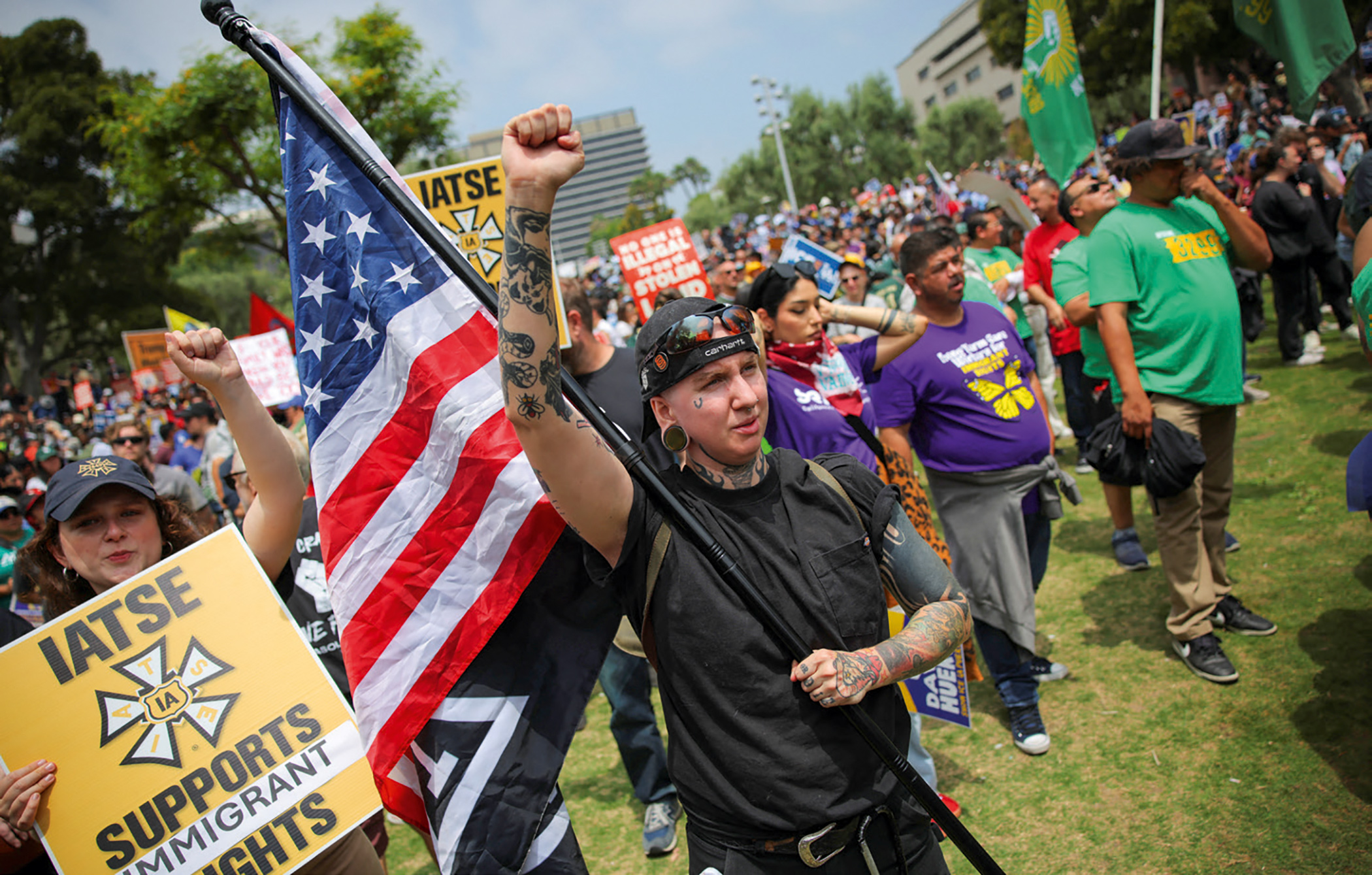
Resisting efforts by Immigration and Customs Enforcement (ICE) agents to detain and disappear immigrant workers has become a particular focus for many unions with and without undocumented workers among their members. Trump’s nativist, racist obsession with immigrants and ‘illegal’ migration has led to an enormous amount of money and resources being shoveled into the ICE budget. The result is the deployment of thousands of government shock troops across the country. ICE has become the most visible sign of the country’s descent into fascism, and comparisons between these masked secret police and the Gestapo secret police are almost too easy. Anti-ICE sentiment has spread from the Left to the mainstream.1 With 15.4 per cent of union members – about 2.2 million workers – identifying as foreign-born, the labour movement is no exception.2
Despite promises to only go after undocumented people who have criminal convictions, ICE has been targeting just about anybody it can catch, from 71-year-old grandmothers to Irish tourists (see Facts, page 23). Its approach has already proven to be deadly. In mid-July, 57-year-old farmworker Jaime Alanís died as a direct result of a surprise raid on a farm in Ventura County, California, expiring from injuries he sustained after falling off of a roof while trying to escape. The United Farm Workers union has pledged to support his family as they grieve, and to ‘continue to work with hundreds of farm worker families navigating the aftermath of this violent raid’.
In June, a 42-year-old lead forklift driver and union member named Maximo Londonio was arrested by US border patrol agents on his way home. The father of three had been on vacation in the Philippines, and had lived in the US for the past 30 years – as a green card holder, he probably expected his return trip to go smoothly. Instead, Londonio was separated from his wife and children, taken to a detention facility in Tacoma, Washington. He had committed no crime, but spent two months there before finally being released. During his internment, members of Londonio’s trade union, the International Association of Machinists and Aerospace Workers (IAM), rallied alongside a bevy of other local unions for his release. At the protests, IAM international president Brian Bryant delivered fiery speeches pledging the entire union’s support for their brother. ‘This is not just a failure of the system – it’s a violation of basic human dignity,’ Bryant stated upon Londonio’s release. ‘No working person should have to go through what Maximo endured in a country that claims to stand for justice and fairness.’
The IAM, which represents thousands of workers in weapons and aerospace manufacturing, is not the first union that springs to mind when one considers the more progressive, socially liberal wing of the US labour movement. Like many US unions, its leadership has spoken out against Trump's ruinous trade policies and attacks on collective bargaining rights, but otherwise shied away from making statements that may have felt ‘too’ political to the conservative members on its rolls. Londonio’s case was different, and the fact they went that hard, that publicly, in condemning the administration’s attacks on immigrant workers has opened up a pathway for other, more skittish unions to start doing the same.
After all, the forklift driver’s kidnapping was not an isolated incident. That same month, David Huerta, president of Service Employees International Union (SEIU) California and SEIU United Service Workers West, representing largely public sector workers, was injured and detained by federal agents while monitoring an ICE raid. Hundreds of union members in 17 cities protested in response, and labour leaders like Liz Schuler, president of the trade union federation AFL-CIO, drew a direct line between Huerta’s arrest and the Trump administration’s targeting of immigrant workers. ‘Hard-working people, and members of our family and our community, are being treated like criminals,’ Huerta stated after his release. ‘We all collectively have to object to this madness because this is not justice.’

Protesting the abduction of union members and leaders is one thing, but labour is also facing the broader issue of Trump’s continued dismantling of critical services and government agencies head-on. The slapdash slash-and-burn tactics being utilized by this administration to shrink the size of the federal government – and, seemingly, make it as inefficient as possible – has resulted in the loss of thousands of unionized jobs. As the regime has moved to purge the civil service of any workers deemed ‘inessential’ or insufficiently aligned with its far-right political project, unions representing public servants like the AFSCME have continually hauled Trump’s lackeys into court. Since January, the union has filed multiple lawsuits to protect its members’ collective bargaining rights (which Trump wants to strip), their rights at work (which Trump wants to minimize) and worker-related agencies’ sensitive data, which Trump wanted to hand over to the Department of Government Efficiency (DOGE) programme, formerly run by far-right billionaire Elon Musk. Pro-labour lawfare may not be as exciting as a brick through a fascist’s window, but it has proven successful in stymying some of the regime’s worst attacks on workers.
It’s not just unions, either, when DOGE tried to eliminate the National Institute for Occupational Health and Safety’s Respiratory Health Division, which tracks and provides services for workers impacted by the current black lung epidemic, a veteran coal miner named Harry Wiley sued. Public outcry over the cuts followed, and as a direct result of his lawsuit, the programme was restored. West Virginia mineworkers retained access to an essential lifeline, and hundreds of jobs were saved.
Lawsuits and protests will not be enough to resist what is coming, though. As esteemed labour historian and author Bill Fletcher Jr wrote recently, it will take the combined efforts of the rank-and-file to truly combat the fascist creep.3 In his view, worker education is our greatest weapon in the fight against the Trump regime’s multi-pronged assaults on human rights, free speech, political freedom and the very earth itself. As ever, the labour movement is not a monolith, and in the US there are plenty of reactionary elements within its ranks. Hell, nearly half of America’s union members voted for Trump! In order to meaningfully address such a failure of ideology, solidarity and empathy and build a movement that’s actually worth its members’ dues money, labour itself must do the hard work of cleaning up its own backyard.
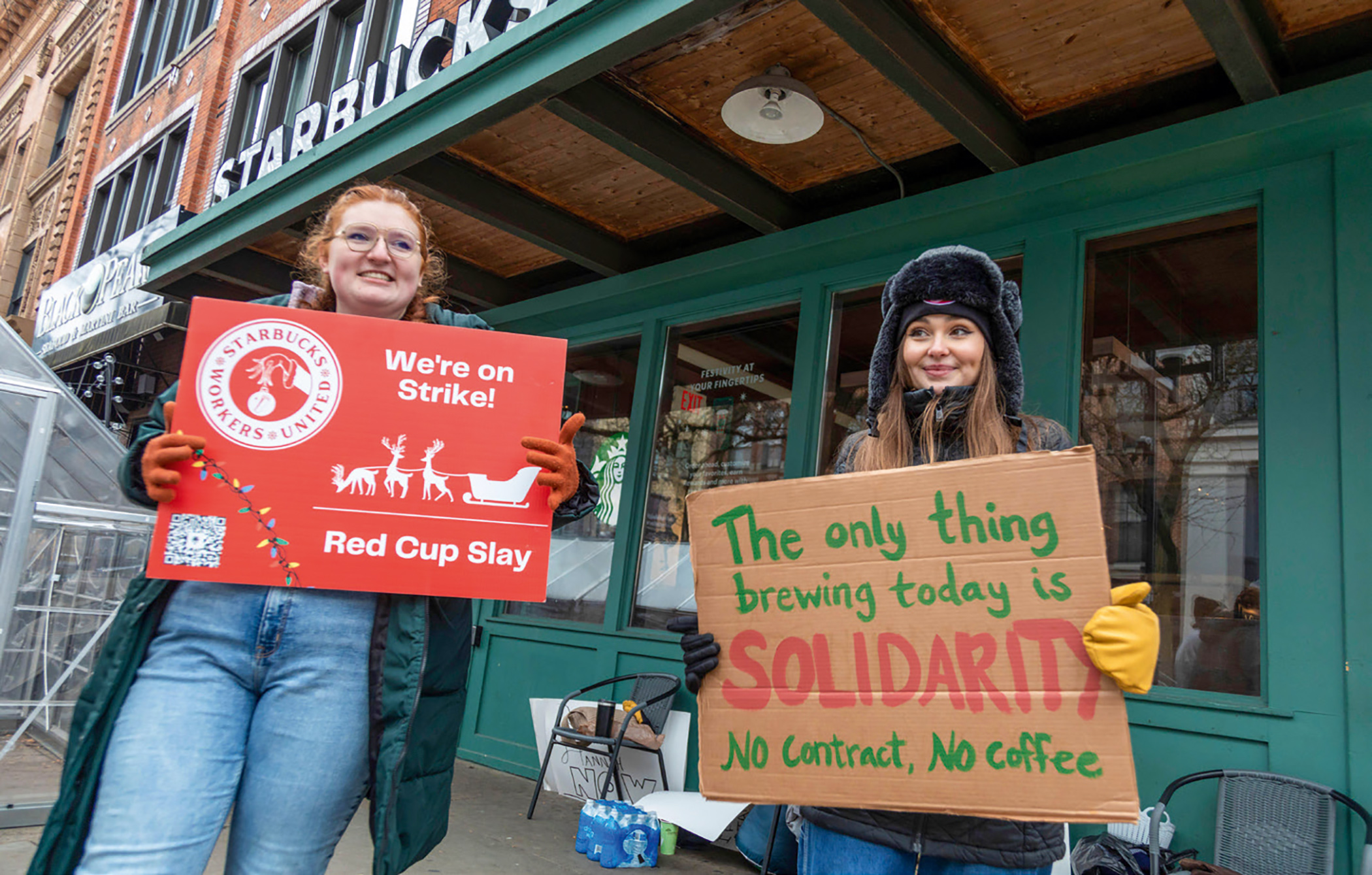
Some of that work is already being done, and some unions are doubling down on increasing members’ political education and emphasizing finding that common ground. Newer labour projects led by and centering on historically marginalized workers have led the way. The Union of Southern Service Workers explicitly connects their anti-racist stance with the exploitation and systemic racism that their members face as Black and brown low-income workers in the South. Starbucks Workers United use their large public platform and nationwide organizing success to support their trans co-workers and stand up for Palestine. Even in more traditionally conservative sectors like the building trades, unions like IUPAT and IUOE are putting in the work to increase diversity, address mental health and substance abuse issues, and support their immigrant members.
It’s high time for the American labour movement to bring back one of the best things about the 1930s: labour’s loud, proud, militant opposition to fascism
These steps are promising. But the work to root out biases, prejudices and blind spots among the labour force still has a long way to go. It’s not impossible, though – we’ve done it before. Radical anti-racist and anti-fascist unions stud America’s labour history like sparkling jewels. Some, like the Industrial Workers of the World, are still around and still marching on the boss. But far too many have lost that fighting spirit, wilted into a milquetoast arm of the Democratic Party, or disappeared altogether. During the 1930s, the US had a strong base of anti-fascist unions, but Cold War-era redbaiting and the rise of anti-union Reaganite conservatism cut many off at the knees (and backstabbing from their own less progressive ‘comrades’ in labour didn’t help).
Since we already appear to be reliving so much of the 1930s right now, it’s high time for the US labour movement to bring back one of the best things about that decade: labour’s loud, proud, militant opposition to fascism. There’s no time to waste – the barbarians are at the gate. They’re coming for us all, now, and we cannot leave anyone behind this time.
- Michael Tesler, ‘ICE’s popularity is plunging, Good Authority, 10 July 2025, a.nin.tl/Ice
- Hayley Brown, ‘Foreign-born workers….’, Center for Economic and Policy Research, 20 May 2025, a.nin.tl/foreign
- Bill Fletcher Jr, ‘Unions as a 21st Century…’, In These Times, 8 April 2025, a.nin.tl/UnionForce
