
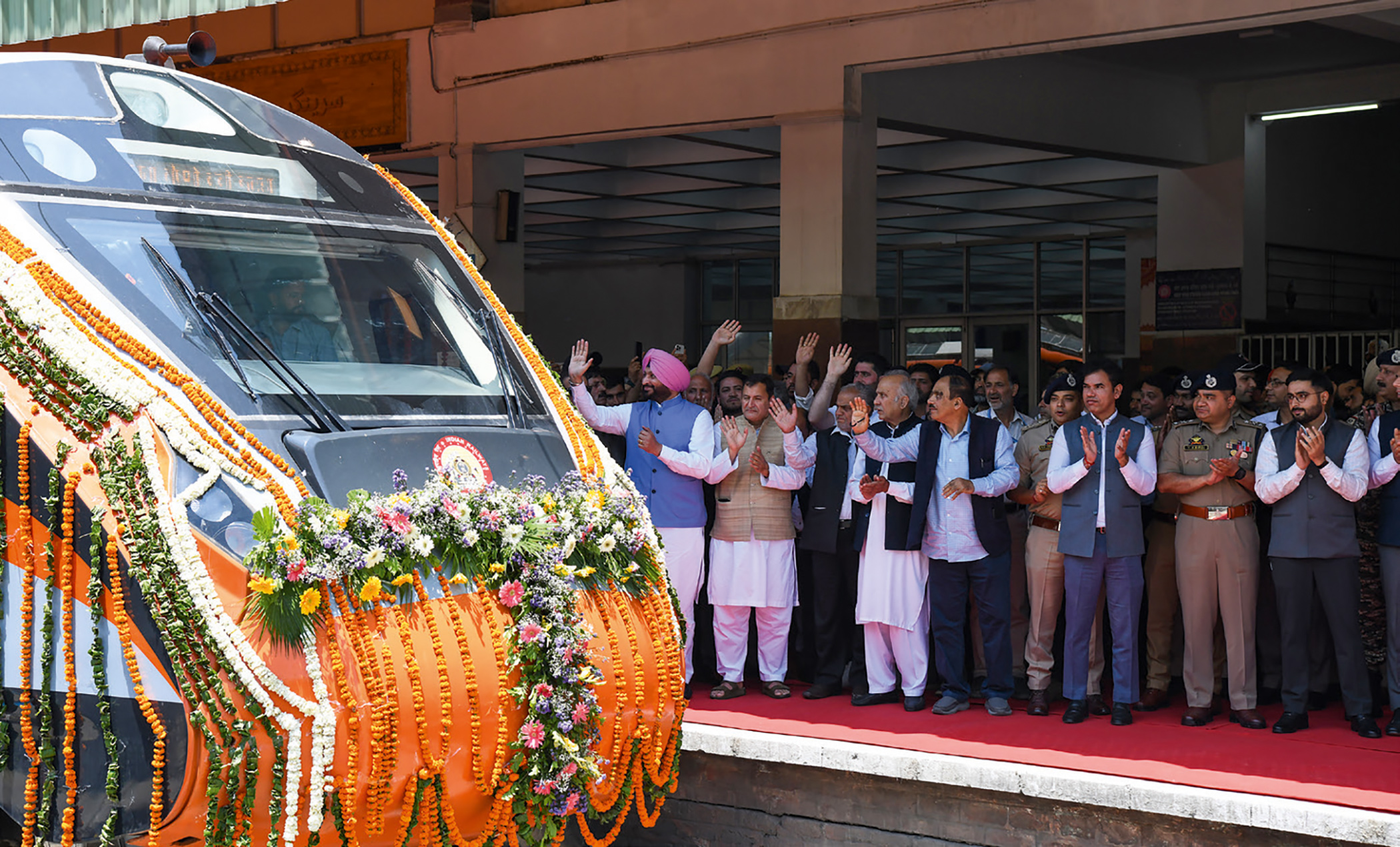
On 6 June, Prime Minister Narendra Modi inaugurated India’s most ambitious railway project to date: the long-awaited Udhampur-Srinagar-Baramulla line, a 272-kilometre route linking the disputed region of Kashmir to the rest of India. Its completion has been met with celebration by the Indian government, but Kashmiris fear that the train might entrench Modi’s control over their lives.
‘The idea of having a rail link to Kashmir dates back to the colonial era,’ says Dr Sheikh Showkat Hussain, a Kashmiri political analyst and human rights activist. But the plans never materialized, he explains, due to logistical challenges and concerns it would ‘ruin the vital ecosystem’ of the Himalayan region. The new line, which includes the world’s tallest railway bridges and miles of tunnels through mountains, was built at a cost of $4.4 billion.
‘But now, everything is viewed from the prism of security,’ Showkat adds. ‘Mobility has prevailed over ecological concerns.’
For many in New Delhi, the railway is a sign of development and national integration. But for Kashmiris, the train’s potential to entrench India’s occupation is impossible to ignore. Since August 2019, when India revoked Jammu and Kashmir’s semi-autonomous status and split it into two centrally-administrated ‘union territories’, the region has been under Modi’s direct control and is now one of the most militarized zones on earth.
‘Railway connectivity to Kashmir had been a long-pending public demand,’ says SP Vaid, the former director general of the Jammu and Kashmir Police. However, he adds: ‘I admit that it holds strategic importance as well. In times of adversity, it will surely help in the quick movement of troops from Delhi to Kashmir.’
For many Kashmiris, the long-overdue infrastructure project arrives in the wake of intense political disenfranchisement. Many Kashmiris have felt marginalized since 2019 with limited political representation and little say in their future.
‘Infrastructure without political rights is just window dressing,’ says a young student activist in Anantnag.
The Udhampur-Srinagar-Baramulla line is only the beginning. In 2023 alone, the Indian government approved five new railway lines in Jammu and Kashmir. Authorities claim the projects will provide employment for locals, but critics argue that it will instead accelerate extractive projects of mining, logging, lithium and hydroelectric ventures. These extractive efforts often benefit outside interests while harming local communities and ecosystems. ‘We’re not against development,’ adds the student activist, ‘but don’t call this progress if it comes at the cost of our land, our identity and without our consent’.
