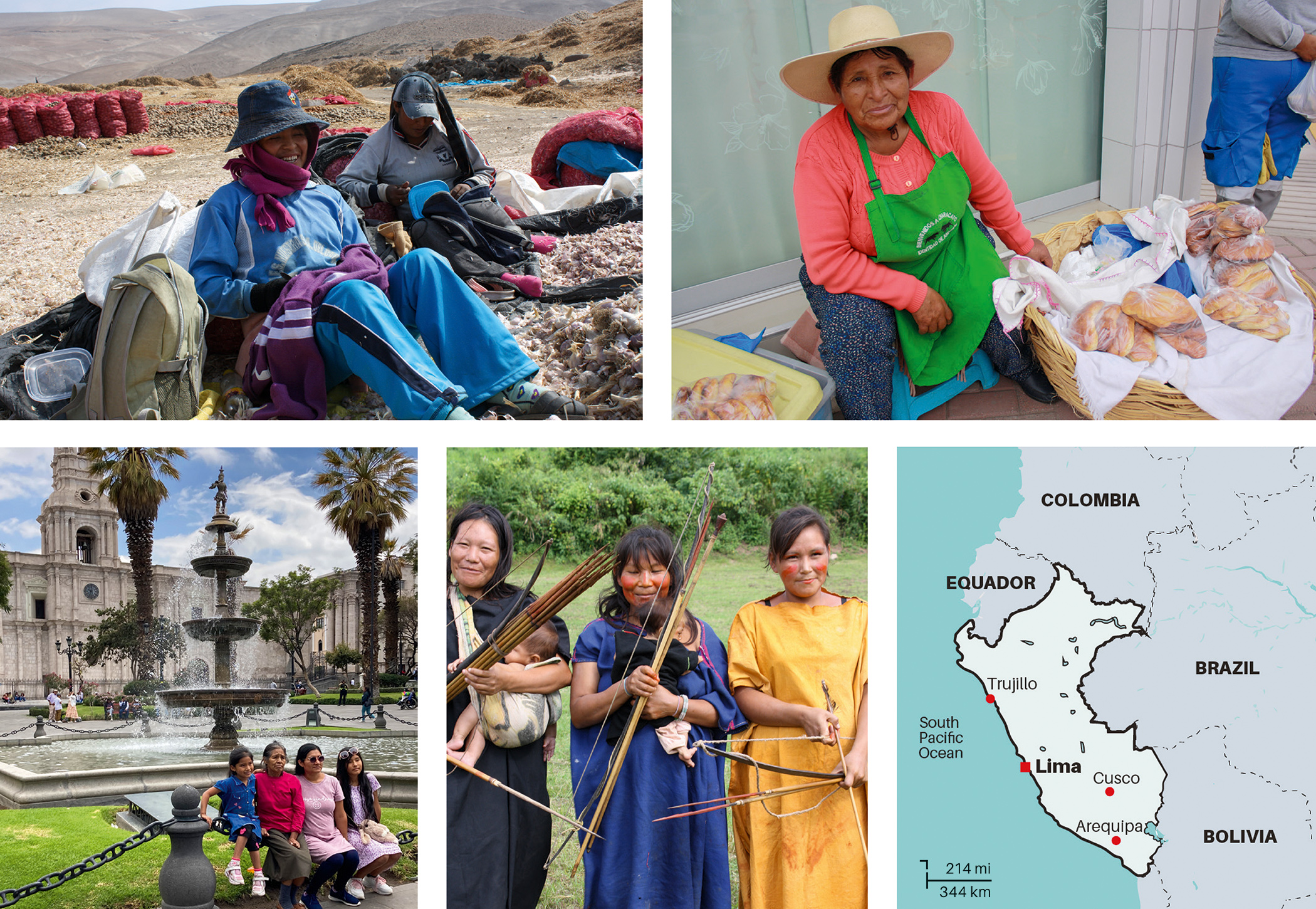
On a stage in Lima’s Plaza de Armas a singer is belting out a popular number in Quechua. The audience, predominantly of Indigenous heritage, is celebrating the 490th anniversary of the city’s founding by Spanish colonizers who, with cunning and brutality, conquered the Quechua-speaking Incas and dismantled their empire. The festivities are the brainchild of Lima’s white, far-right mayor Rafael López Aliaga, a presidential hopeful who has dedicated himself to restoring colonial ‘glories’.
If this puzzles you, welcome to Peru – a political maverick that regularly defies expectations. South America’s many 20th century military coups were virtually synonymous with far-right politics and US imperialism. Not Peru’s. Its 1968 coup, led by General Juan Velasco, was leftwing and had land reform at its heart.
While most South American revolutionary movements were shaped by Marxist-Leninist thinking, Peru’s Shining Path (Sendero Luminoso) developed its own, ultra-violent, Maoism. For almost two decades Peru was engulfed in an internal war that claimed 69,000 lives, most poor and Indigenous. Government forces and Shining Path were equally responsible.
Peru is blessed with a rich and ancient history, stunning geography – coastal desert, Andean peaks, Amazonian rainforest – and tremendous natural resource wealth. During the rule of Alberto Fujimori (1990-2000) the country became a poster child for neoliberalism. Multinational corporations were welcomed with open arms. No matter if they depleted and poisoned water sources and trashed farmers’ livelihoods. Violent social conflicts fuelled by extractivism became the norm. Corruption spiralled. Two ex-presidents (Alejandro Toledo and Ollanta Humala) are serving long sentences for corruption; two more (Pedro Pablo Kuczynski and Martin Vizcarra) are facing trial; Alan García killed himself prior to arrest, and Fujimori, who died last year, was ultimately imprisoned for commanding death squads.
Peru saw rapid economic growth nonetheless, helped by soaring commodity prices between 2001-11. The official poverty rate halved from 42 per cent in 2007 to 20 per cent in 2019. But the Covid-19 pandemic laid bare the country’s inequalities and the weakness of its state institutions. Peru had more Covid deaths per capita than anywhere in the world; worst hit were people living in the Amazon.
As vice-president, Dina Boluarte was appointed to the top job by Congress in 2022 after the sitting left-wing president Pedro Castillo, facing impeachment over alleged corruption, made a botched attempt to dissolve Congress and rule by decree. He was ousted and is now in jail, charged with ‘rebellion’ and ‘grave abuse of authority’.
Congress enjoys a public approval rate of just two per cent. Boluarte’s is around four per cent. But thanks to alliances made with rightwing parties, including that of presidential candidate Keiko Fujimori, Boluarte has clung to power, had a nose job and doubled her salary. She has never accepted responsibility for the deaths of around 50 anti-government protesters shot by armed forces under her control in 2022-23. Instead, her government has systematically weakened the judiciary’s independence, threatening rupture with human rights treaties.
Meanwhile, Congress is pushing through new laws that take a sledgehammer to civil liberties, environmental protections, Indigenous rights, investigative journalism and civil society.
Polls show that the rise in violent organized crime, corruption and injustice are what bother citizens most. Elections are due in April 2026 and voters will have 43 parties to choose from, but rarely has public trust in politicians or even democracy itself been so low. If history is anything to go by, expect the unexpected.
At a glance
- Leader
- President Dina Boluarte
- Economy
- GNI per capita $7,090 in 2023 (Chile $15,800, UK $47,700) Peru primarily exports raw materials, with China, the US and Canada its biggest trading partners. Mining, agriculture and tourism are the largest industries. More than 70% of the labour force is informal. Subsistence farming remains vital to the rural poor.
- Main Exports
- Copper (world’s 3rd largest), gold, zinc, petroleum and gas, fishmeal, agricultural products. World’s largest exporter of grapes.
- Monetary unit
- Peruvian sol (1 PEN = $0.28)
- Population
- Estimated 34.7 million. People per km2: 26 (Chile 26, UK 279). Annual population growth 1.1%. Peru hosts 1.6 million Venezuelan refugees.
- Health
- Infant mortality per 1,000 live births: 15.8 (Chile 7.2, UK 4.1) Maternal mortality per 100,000 live births: 51 (Chile 10, UK 7). Access to healthcare is uneven, with long waiting times.
- Environment
- More than 50% of Peru’s glaciers have melted in the past 50 years due to global heating, causing water scarcity exacerbated by mining. A new ‘anti-forestry law’ encourages expansion of agro-industrial activities into the Amazon basin. The main drivers of deforestation are mining, palm oil and logging.
- Culture
- Peru has a rich ethnic mix, reflected in its art, clothes, traditions, music and cuisines. Official census self-identification of 60.2% as mestizo (mixed Indigenous and white) and 25.8% as Indigenous is questioned by campaigners who believe the former is over- and the latter under-estimated due to persistent prejudice. 5.9% identify as white, 3.6% as of African descent, 1.2% other. The Peruvian Amazon is home to at least 20 Indigenous groups living in voluntary isolation.
- Religion
- Roman Catholic (66%), Protestant (22.4%), co-existing with traditional Indigenous belief systems.
- Language
- Spanish, Quechua and Aymara are the three official languages, but there are at least 40 other Indigenous languages.
- Hdi
- 0.794 (Chile 0.878, UK 0.946). 79th out of 193.
