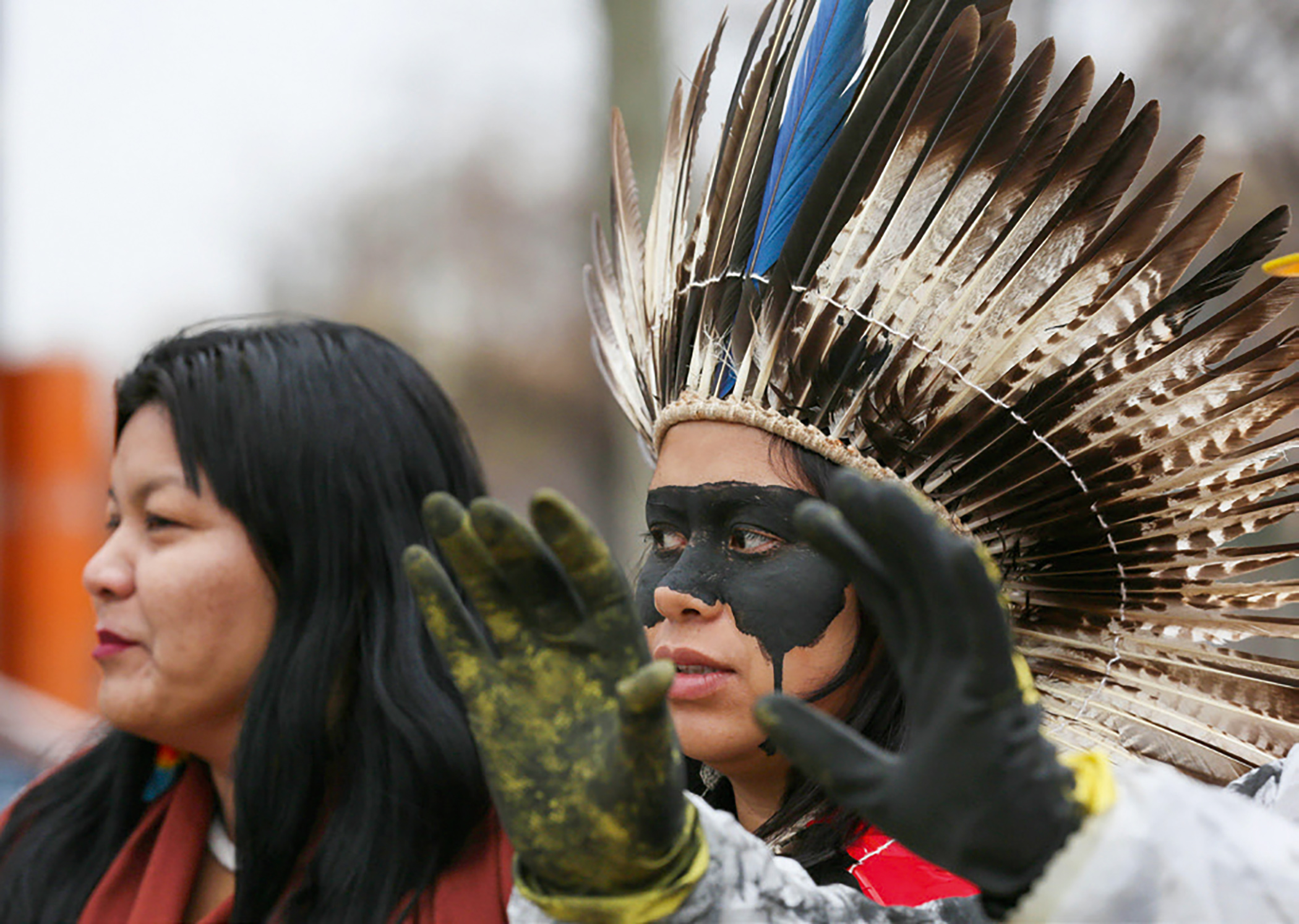
The answer is us. That’s the message of Indigenous organizations from around the world as they mobilize for the COP30 climate conference in November this year. Their campaign refers to the vital role that Indigenous peoples already play in defending the world’s forests, lands and waters from environmental devastation.1
Indigenous campaigners brought their demands to the Brazilian National Congress in a thousands-strong march in April, and raised them again at the preparatory UN climate talks in Bonn in June.
Brazil’s approach in hosting the 30th Conference of the Parties offers a marked change in tone from the restrictions placed on activists at previous conferences. COP30 president André Corrêa do Lago has explicitly invited civil society and Indigenous leaders to take part. But the country’s government has so far refused the request of Indigenous organizations to co-host the event and share its presidency.2
Indigenous representatives have laid out five key demands for the conference to adopt, first and foremost being the right to free, prior and informed consent to any industrial activity in their lands.3 A truly just transition away from fossil fuels requires that no such activity takes place without the active consent of the Indigenous peoples of that territory.
Further demands include the need for climate adaptation plans to respect and include Indigenous knowledge; for Indigenous food systems to be recognized as a key climate solution; and for climate finance to be channeled directly to Indigenous organizations. These measures should be promoted, rather than ‘false solutions’ such as carbon offsetting that ‘fail to cut emissions and violate our rights’, they argue.
Raising these demands within the COP process can be challenging, explains Jocabed R Solano Miselis, director of Memoria Indígena, from the Gunadule nation in Panama.
‘For some people, these talks are about decisions on paper,’ she says. ‘For us, it is life or death. Indigenous people are suffering right now. But not everyone in the talks is thinking this way, especially when it comes to decisions that have an economic or political impact. I understand that consensus and compromise can be hard. But this is an emergency.’
Under current rules, Indigenous representatives at COP – like the rest of civil society – are restricted to observer roles, and rely on national delegations to grant them access to the ‘blue zone’ where the main deliberations take place. Even there, they cannot take part in all of the core discussions, as they are not formally recognized as representatives of their territories.
‘Accreditation is not enough,’ says Solano. ‘We’re not just there to be photographed like a tourist attraction. We need a voice in the decision-making. If we want to see justice, then the people most affected by these decisions need to be at the table.’
Even for those granted accreditation, the costs of getting to the talks – which are taking place in Belem, in the Amazon forest itself – are another major barrier to participation. Organizers have been criticized for holding the event in a location where the prices of flights and accommodation could bar many from attending – a barrier that well-funded corporate lobbyists will not face.
Despite these challenges, Solano believes it is vital that Indigenous peoples are present at the talks, and for everyone to share and amplify the voices and demands of Indigenous peoples: ‘80 per cent of the world’s biodiversity is protected by Indigenous peoples. Our voices need to be heard at every level.’
- The Answer is Us, arespostasomosnos.org/en/
- Amanda Magnani, ‘Brazil’s civil society pledges tested as COP30 climate summit approaches’, Dialogue Earth, 3 June 2025, a.nin.tl/pledges
- ‘Statement by Sandra Ceballos and Wara Ruíz Condori on behalf of the International Indigenous Peoples’ Forum on Climate Change’, 25 June 2025, a.nin.tl/closing
