For some, the feminist call to abolish the family is just a farce. For others, it evokes dystopian images: birthing pods and eliminating natural family love in the name of a perfectly functioning society. This perspective assumes that the family is natural, eternal and above all, good. Popular media upholds the family as the highest social bond – and for some that is the reality, whether it’s biological relationships or the ‘chosen family’. Family is synonymous with unconditional love, support and duty. In the immortal words of Vin Diesel in Fast and Furious, ‘without family, you’ve got nothing’.
There’s a nugget of truth in Mr Diesel’s words. As Marxist feminist Silvia Federici argued in Caliban and the Witch, a precondition for capitalism’s existence was the privatizing of reproductive labour within the family. Thus, the family became capitalism’s prime place for what’s called social reproduction – where gendered roles became the ‘natural’ order. The family reproduces workers both daily and generationally through unwaged labour, mostly that of women. Cooking, cleaning, caring, child rearing and elder care are all needed to keep workers alive and able to do their jobs. By privatizing access to the means of day-to-day survival within the family unit, capitalism proves Diesel somewhat correct.
This hides the fact that our entire system rests on gendered, unpaid labour. And once survival depends on family, escaping it becomes near impossible, even when the family is violent. A 2018 UN report, released with the title, ‘Home, the most dangerous place for women…’ found that the majority of female homicide victims worldwide were killed by partners or family members.1 Most child abuse also occurs within the family walls. Equating the family to unconditional love hides vast systemic abuse behind the assumption that families as a rule operate through love.
For these reasons feminists have long argued that the family home is not necessarily a safe haven from power, violence and exploitation. For radical family abolitionists, to overcome this hidden violence and the exploitation associated with the gendered division of labour requires the transformation of care from a private to a collaborative public activity. In reality, humans are interdependent beyond the family, yet society revolves around it. Those who challenge that dynamic are seen as deviant.
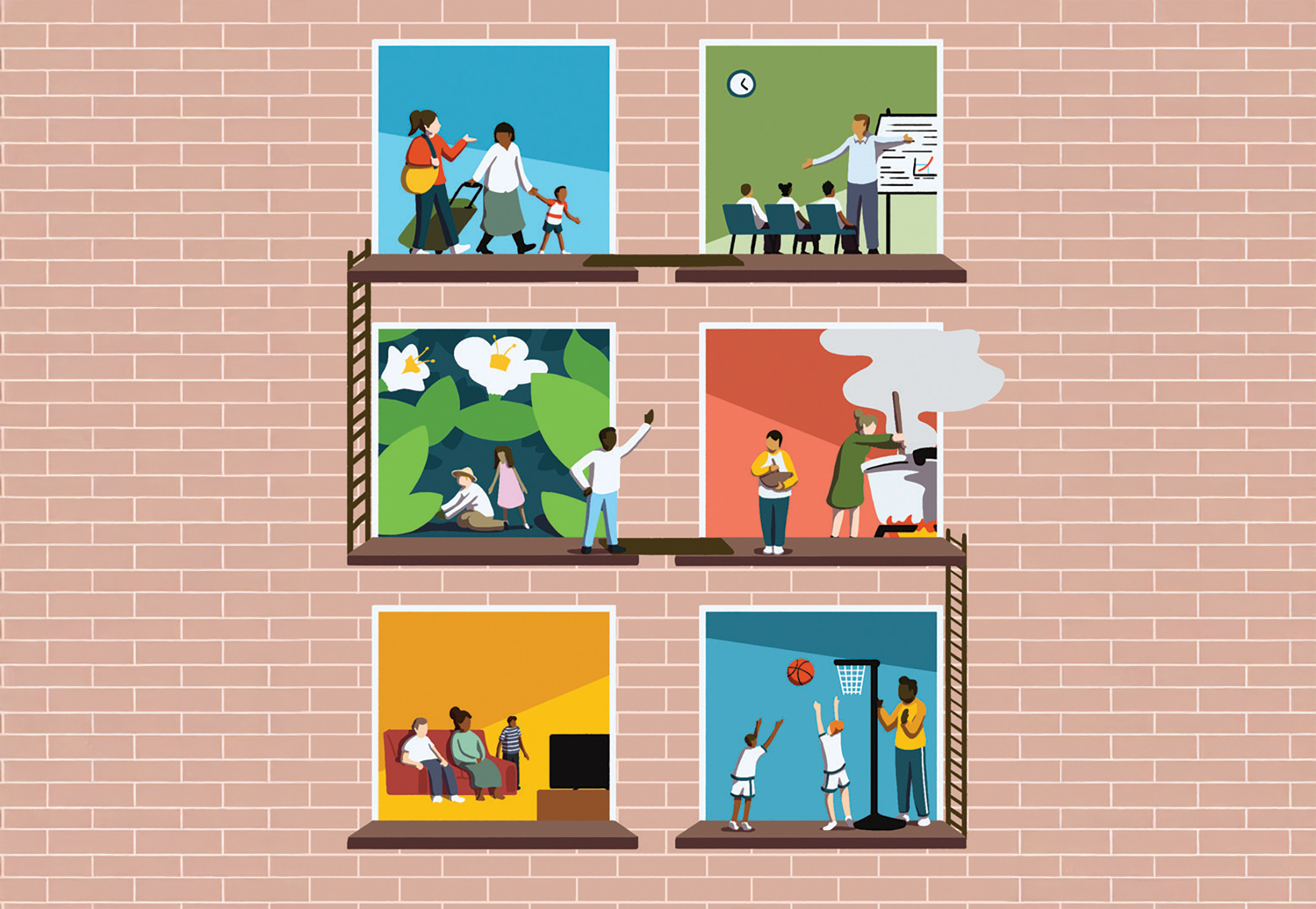
In a radical vision of abolition, scholars KD Griffiths and JJ Gleeson describe a socialized creche that blends education, care, food and housing into one accessible system across the first two decades of a person’s life.2 Instead of families struggling alone to juggle care responsibilities, children would live, socialize, eat and be educated together under the supervision of highly trained professional caring labourers. Parents may spend as much time as they want with their children but the aim is to disrupt both the normative and economic compulsion to maintain the family unit.
Moving beyond the family doesn’t have to be all or nothing. Abolition can be pursued in ways that are both immediate and popular. Radically expanding social housing, introducing universal basic income and welfare for all would mean people can more easily escape the family unit. More speculatively, by developing community-based cultures with communal kitchens and laundry facilities, we can start chiselling away at the barriers between households and encourage a society where people can more easily move between kin units to seek help or security. By creating a more publicly caring society, family abolition may actually allow those who want children to have them without fear of poverty and social isolation. More still, accessible social housing would mean no relationship, familial or romantic, would be coloured by the fear of homelessness, allowing us to love more freely.
Some critics of abolition, including Black feminists, argue that the family can be a place of refuge, including refuge from racism. But abolition doesn’t mean destroying all bonds of care and love. It would simply allow people more agency to choose the relationships that actually work for them. It’s for this reason that, following radical geographer Ruth Wilson Gilmore on prison abolition, we can understand that [family] ‘abolition is not absence, it is presence’.
- ‘Home, the most dangerous…’, United Nations: Office on Drugs and Crime, November 2018, a.nin.tl/femicide
- KD Griffiths and JJ Gleeson, ‘Kinderkommunismus: A Feminist Analysis…’, Ritual, 2015, a.nin.tl/nursery
