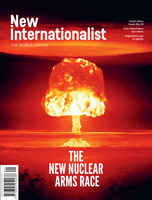
In the early 1980s the fear of nuclear war permeated daily life in Britain. Margaret Thatcher’s government pushed ‘Protect and Survive’ leaflets through every letterbox, instructing families on how to prepare for an attack. Simulated exercises ran in town halls and schools. US cruise missiles were arriving at RAF Greenham Common – an airbase just over 88 kilometres west of London – with each warhead more powerful than the bomb that flattened Hiroshima.
As anxiety grew, so did opposition. Tens of thousands joined the Campaign for Nuclear Disarmament (CND). With US ‘strike first’ missiles bound for Britain, many feared Ronald Reagan was outsourcing the frontline of his nuclear war with the Soviet Union to Europe. On 6 June 1982, 200,000 marched on the streets of London demanding disarmament. That winter, 30,000 women held hands around the 14-kilometre perimeter fence at Greenham Common.
