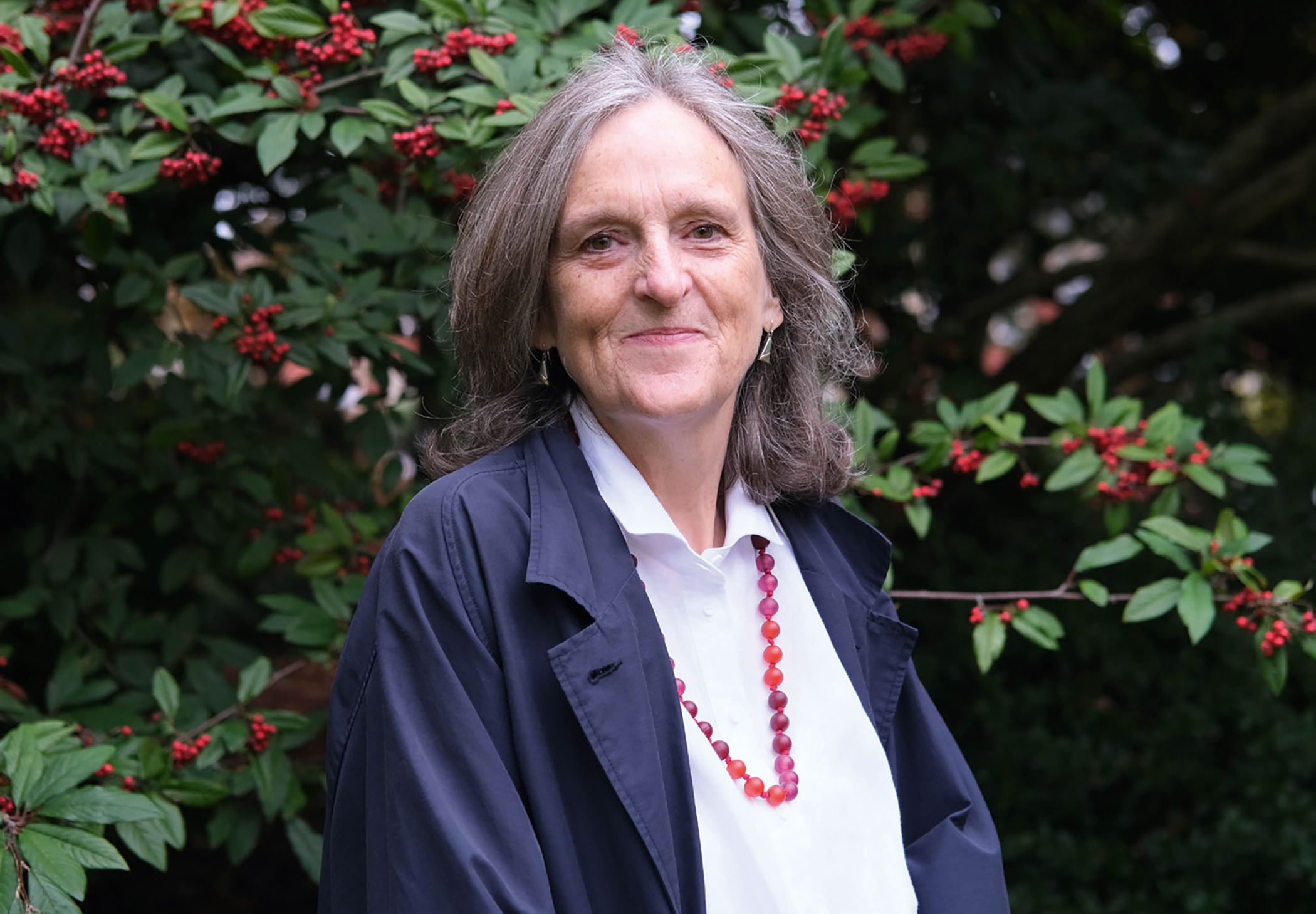
As I sit down with Tessa Hadley in a large sunlit room at Belfast’s Crescent Arts Centre, a staff member kindly places a cup of coffee in front of me. He then begins fiddling with the AV equipment behind us, and sensing my slight discomfort, says: ‘You’re doing an event here, right?’ It’s only then that I register that there are rows of chairs in front of us. For a split second, I feel like Guy Goma, the man who went into the BBC for a job interview in IT – only to find he was being interviewed live on television in a case of mistaken identity.
My rationality returns, and we both confirm that no, we are not about to run a Belfast Book Festival event. But it seems fitting that my sense of the room around me has changed thanks to this intervention. Of any contemporary novelists I’ve read, Hadley has the superior skill in conjuring setting from character – and vice versa. ‘They do come intertwined,’ she tells me. She believes character is ‘produced by a kind of inextricably tangled mix of something intrinsic and then all the environmental influences – the home, the place, the aesthetic, the feel of a historical moment’. And the setting never seems to her like ‘something you add on later’.
For Hadley, ‘making a scene’ runs in the family. Her mother, a ‘dressmaker and housewife’, had a knack for home refurbishments. ‘That sense of scene-building… I think I inherit that. I’m not nearly as good at DIY… I just write it instead, which is easier in some ways and harder in others.’ In her recent novels The Past and Late in the Day, she takes it a step further – with houses steeped in memory almost becoming characters in their own right.
Hadley has just finished the first draft of a ‘big family saga’, and seems unsure as to whether it will work in its current form. In spite of her success in the past two decades, and her intellectual confidence, she has a real modesty when talking about her work – perhaps reflective of the many rejections she received early on.
Having graduated from Cambridge and failed to find publishers for a number of novels, she returned to academia in her 30s, wrote a PhD thesis and began teaching creative writing. She was 46 when her first novel, Accidents In The Home, was published.
The Party, Hadley’s latest book, is a novella about sisters Evelyn and Moira, who find themselves entangled with a pair of sophisticated and yet repulsive men in post-war Bristol. Moira’s fiancé has left for police work in the Malaya ‘emergency’ – the name given to the anti-colonial uprising – after she refused to elope with him to Paris. Evelyn hates war, and particularly the ‘sly’ look that appears ‘on men’s faces when they talk about war’.
Yet in common with Hadley’s other work, this political intrusion only ever appears on the margins. I suggest that many of her characters are rather post-idealistic. Is that fair? ‘I feel we significantly live in a post-idealistic age,’ she replies. ‘And I don’t necessarily think I mean anything very bad by that. Sometimes we have a sense that in our politics we’re too ready to feel we live in the worst of all possible times, and then… you think, it probably isn’t really the worst of all possible times – yet.’
‘There’s an aesthetic about putting politics in a novel. But if you expand it at too much length, it breaks the magic in some way’
The ‘only’ books Hadley can write, she says, ‘are about ordinary middle-class people mostly, Britain in our time more or less’. She focuses on ‘their intricate small, big pains and sorrows and joys’, but given the nature of the world, their bubble can’t simply exist unpunctured. She feels that in a position of privilege, ‘you should feel very uncomfortable, you should feel the pressure of the world all the time’.
When writing, it’s about getting the right balance. ‘There’s an aesthetic about putting politics in a novel. I think it’s a lovely thing as a writer if you can make your characters be intelligent, say good things, and muddle things, have arguments. But if you expand it at too much length, it’s ugly on the page. It breaks the magic in some way.’
Hadley’s doctorate was on Henry James – but the writer who has influenced her practice the most is the Anglo-Irish novelist Elizabeth Bowen. She’s not the easiest of reads, but Hadley says it’s the ‘density of her writing’ – capturing ‘furniture, buildings, light, atmosphere, the aesthetics about being inside a space’ – that delivers its wonder. ‘What she does in finding words to make that envelope of the real be vivid – she has a preternatural gift.’
It’s the value she places in this kind of writing which makes Hadley less concerned than many about the rise of artificial intelligence (AI). She turned down a request from Cambridge University Press to feed her book on Henry James into a large language model, and ‘hates’ the notion of AI ‘making word salad’. But such machines will never, she believes, ‘have sweat on their forehead trying to conjure up “what is this room”, because they’re not in a room, there is no “they”.’
